Heart Line
Reflects how you love, feel, and relate to others.
If your line looks like this
- •Long, reaching the index — idealistic love
- •Curving upward — expressive feelings
- •Straight and short — reserved affection
An interactive palmistry tool: tap the four major palm lines to explore their meanings. Heart, Head, Life, and Fate lines at a glance.
Tap a line on the palm to explore the Heart, Head, Life, and Fate lines.
👆 Tap a line
The selected line lifts forward and glows — traced from the real palm shape.
Reflects how you love, feel, and relate to others.
If your line looks like this
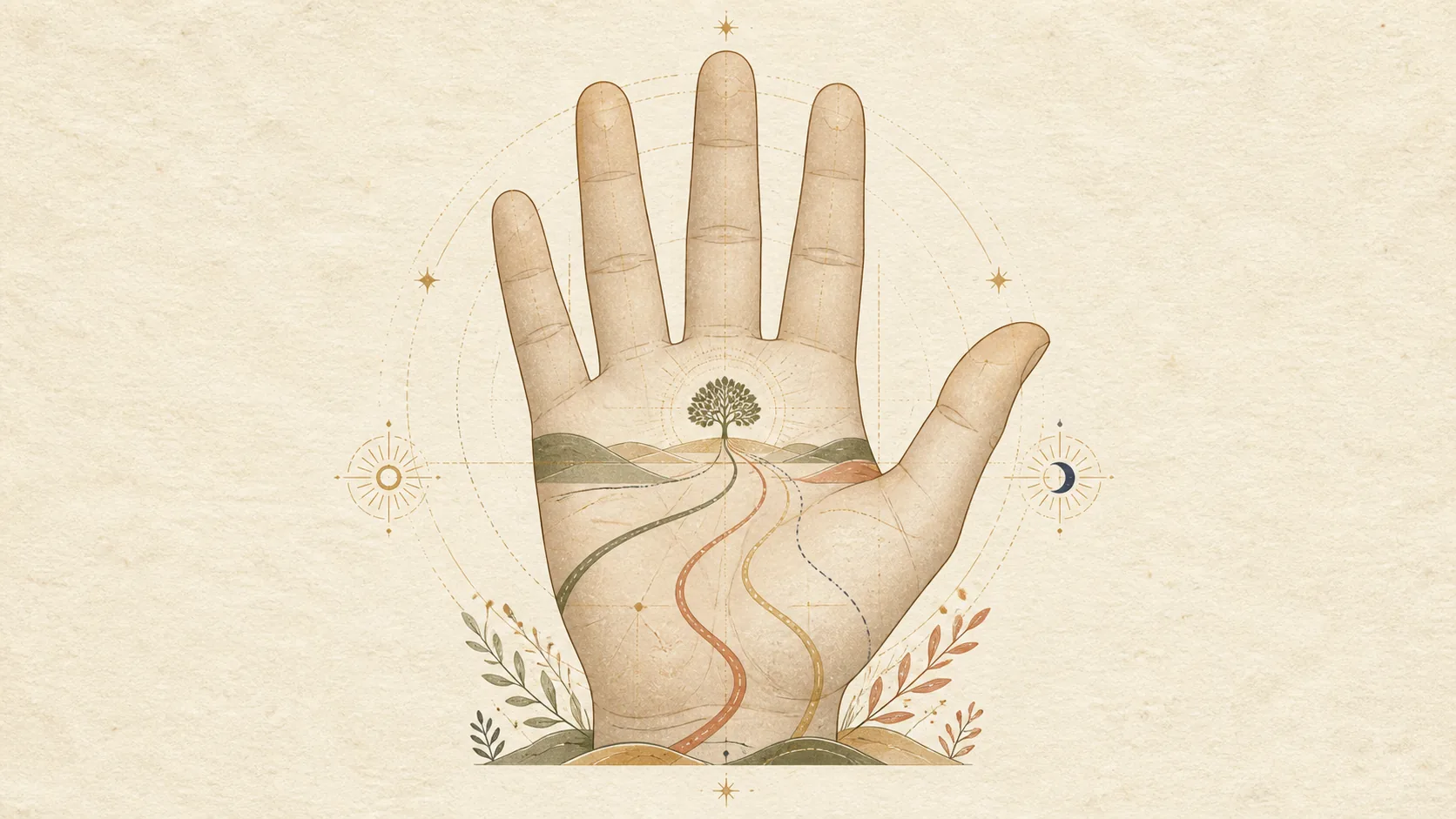
Palmistry observes lines such as the life line, heart line, head line, and fate line to reflect temperament, attention, and ways of relating to life. The lines of the hand do not diagnose health. Use the result for self-understanding and light conversation.
The curve around the thumb is read as vitality and life rhythm, not literal lifespan.
The line beneath the fingers suggests emotional expression and relationship style.
These lines can symbolize thinking habits and direction, without fixing destiny.
Palm traditions often compare the dominant and non-dominant hands for current habits and inherited tendencies.
Avoid judging from length alone; look at depth, flow, hand shape, and overall pattern.
Treat the result as a question about how you describe yourself, not as a personality verdict.
The life line is the major line that usually curves around the base of the thumb and the mount below it. In palmistry, it is traditionally read as a symbolic line of vitality, grounding, stamina, and life rhythm. It does not predict lifespan, diagnose health, or determine a fixed fate. </HighlightBox>
The life line usually begins near the space between the thumb and index finger, then arcs downward around the thumb base toward the wrist. Readers often trace its curve around the fleshy area below the thumb, sometimes called the Mount of Venus in Western palmistry.
Because the name sounds dramatic, this line is often misunderstood. In careful definition work, the life line is not a clock, a death marker, or a medical chart. Its length, depth, branches, and breaks belong to palmistry's symbolic vocabulary, not to evidence-based health prediction.
The life line is traditionally read as a symbol of vitality and grounding. A clear, broad curve may be described in folklore as steady energy, physical presence, or strong rootedness in daily life. A line that stays close to the thumb may be read as more reserved or self-contained. Branches may be discussed as symbols of movement, travel, changing routines, or shifting life focus.
Some readers also compare the life line with the head line at the starting point. A joined beginning may be interpreted as cautious or family-connected, while a separated beginning may be read as independent. These interpretations are traditional and conversational, not factual claims about the body.
The most important correction is simple: a short life line does not mean a short life. A broken life line does not mean a fatal event. A faint life line does not mean illness, weakness, infertility, disability, or poor health.
Palm lines can be affected by ordinary hand shape, skin texture, work patterns, age, scars, and natural variation. If someone has a real concern about pain, skin changes, circulation, injury, or other physical symptoms, the appropriate response is medical care, not palm reading.
Palmistry is for entertainment, self-reflection, and cultural learning. Palm lines do not diagnose health, disease, or medical conditions, and palmistry is not medical, financial, or legal advice. For the broader context, see Palmistry.
The head line is the major line usually found across the middle of the palm. Palmistry traditionally connects it with thinking style, attention, judgment, planning, and how a person approaches decisions. This is a symbolic and cultural reading, not a clinical assessment, medical sign, intelligence test, or fixed prediction of life outcomes. </HighlightBox>
The head line is commonly traced through the center of the palm. It often begins near the space between the thumb and index finger, sometimes close to the life line, and then travels across the palm toward the outer edge.
Readers traditionally observe whether it is long or short, straight or sloping, deep or faint, and whether it appears separate from or joined to the life line near the beginning. These observations are part of palmistry's visual language. They are not measurements of intelligence, mental health, neurological status, or moral character.
The head line is traditionally read as a symbol of thought. A straighter head line is often described as practical, structured, or analytical in folklore. A more sloping head line may be read as imaginative, intuitive, or flexible. A long line may be associated with sustained focus, while a shorter line may be described as direct or action-oriented.
Some traditions pay attention to the line's start. A head line joined to the life line may be interpreted as cautious or family-influenced, while a separated start may be read as independent or self-directed. Breaks, chains, or changes in depth are usually treated as symbols of changing priorities or periods of mental strain.
These meanings are traditional interpretations only. They should be used as prompts for reflection, not as evidence about ability, diagnosis, or destiny.
The head line does not diagnose ADHD, anxiety, dementia, depression, learning difference, brain injury, or any other medical or psychological condition. It also does not reveal IQ, guarantee good judgment, or prove that someone is rational, creative, careless, or confused.
At its most responsible, a head line reading can invite questions: Do you make decisions quickly or slowly? Do you trust plans, instincts, or both? Where do you need clearer thinking before acting? Those questions can be useful without claiming that the hand contains clinical facts.
Palmistry is for entertainment, self-reflection, and cultural learning. Palm lines do not diagnose health, disease, or medical conditions, and palmistry is not medical, financial, or legal advice. For the broader context, see Palmistry.
The heart line is the major line usually traced across the upper palm, below the fingers. In palmistry, it is traditionally read as a symbolic clue about emotion, affection, attachment, and how a person relates to closeness. This is a cultural and reflective interpretation, not a medical reading, a relationship diagnosis, or a fixed fate. </HighlightBox>
The heart line usually sits near the top of the palm, running horizontally or slightly curved beneath the fingers. Many readers begin near the outer edge of the palm below the little finger and trace the line inward toward the index or middle finger area.
Its exact shape varies. Some people have a clear, continuous line; others have a faint, chained, forked, or interrupted line. Palmistry traditions treat those visible features as interpretive symbols, but they should be understood as part of folklore and self-reflection rather than evidence about a person's emotional future.
The heart line is traditionally read as a line of feeling. In common palmistry manuals and reading styles, it may be discussed in relation to affection, romantic expression, emotional openness, loyalty, sensitivity, and expectations in close relationships.
A long or gently curved heart line is often described as expressive or warm in traditional language. A straighter line may be framed as reserved, steady, or more controlled in emotional display. Forks, breaks, or chains may be read as symbols of mixed feelings, emotional lessons, or relationship complexity.
These are symbolic readings. They do not prove how someone loves, whether a relationship will succeed, or what a person is capable of feeling.
The heart line does not diagnose mental health, emotional disorder, trauma, fertility, heart disease, or relationship destiny. A broken or faint heart line does not mean a person is unable to love, and a deep line does not guarantee a stable romance.
Responsible palmistry treats the heart line as a prompt for conversation: What does closeness mean to you? How do you express care? Where do you need firmer boundaries or more trust? Those questions can support reflection without turning the palm into a claim about medical facts or fate.
Palmistry is for entertainment, self-reflection, and cultural learning. Palm lines do not diagnose health, disease, or medical conditions, and palmistry is not medical, financial, or legal advice. For the broader context, see Palmistry.
The fate line is a vertical palm line, when visible, often traced upward through the center of the palm toward the middle finger. Palmistry traditionally connects it with vocation, life direction, responsibility, timing, and outside pressure. This is symbolic cultural interpretation, not a fixed destiny, career forecast, or financial reading. </HighlightBox>
The fate line is commonly described as a vertical line rising from the lower palm toward the middle finger. It may begin near the wrist, the center of the palm, the life line, or the outer lower palm. In some hands it is strong and clear; in others it is faint, fragmented, or absent.
Unlike the heart, head, and life lines, the fate line is not equally visible on every palm. Responsible palmistry does not treat its absence as a failure or a bad omen. It is simply one feature that some reading traditions choose to include when discussing direction and responsibility.
The fate line is traditionally read as a symbol of path, work, obligation, and external influence. A clear vertical line may be described as a strong sense of direction or a life shaped by visible responsibilities. A line that starts from the life line may be read as self-built effort, while a line rising from the outer palm may be associated with social support, public contact, or outside influence.
Breaks, shifts, or changes in depth are often interpreted as symbolic changes in work, identity, family duty, social pressure, or major commitments. Some readers also connect different parts of the line with stages of life, but those timing systems are conventions within palmistry rather than reliable forecasts.
The fate line does not prove destiny. It does not guarantee career success, failure, wealth, poverty, fame, unemployment, marriage, or a fixed future. A missing fate line does not mean that someone lacks purpose, discipline, or direction.
The word "fate" can make the line sound absolute, but a careful reading should frame it as a reflective symbol. It may invite questions about pressure, duty, ambition, and how much of a person's path feels chosen versus imposed. It should not be used to make financial, career, or legal decisions.
Palmistry is for entertainment, self-reflection, and cultural learning. Palm lines do not diagnose health, disease, or medical conditions, and palmistry is not medical, financial, or legal advice. For the broader context, see Palmistry.
No. Palmistry is not a medical tool. If you have pain, skin changes, or health concerns, consult a medical professional.
No. Contemporary symbolic readings treat the life line as vitality, rhythm, and energy style rather than lifespan.
The look of the hand can change with use, skin condition, and time. It is better read as a changing story than fixed fate.
Palmistry results are for entertainment and self-reflection. They do not replace medical diagnosis, treatment, or health decisions.