Snake
Creatures
- fortune
- conception dream
- change
- shedding
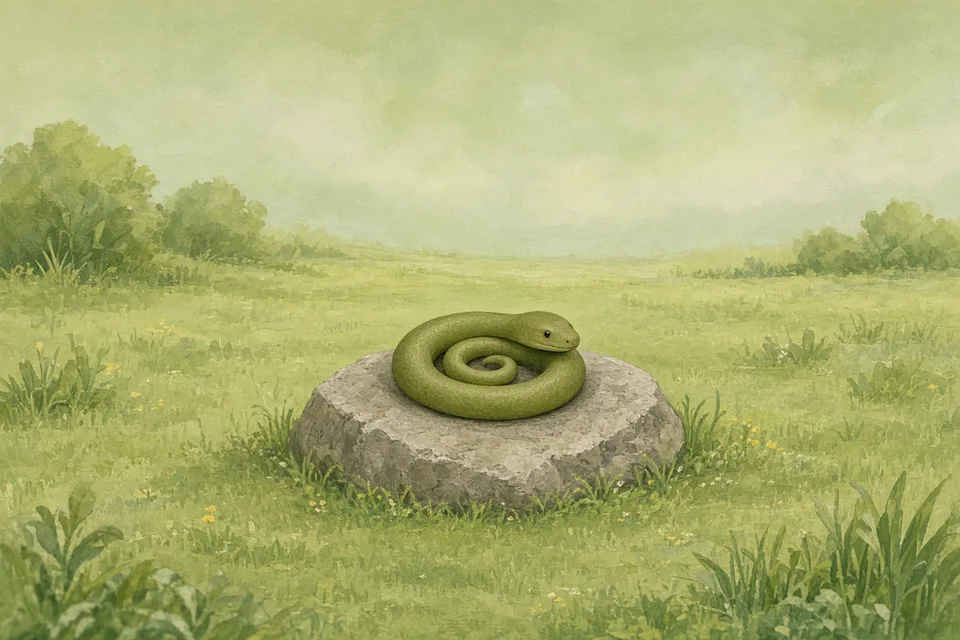
In the traditional reading
East Asian manuals read the snake as fortune and as a conception dream — behind it lies the snake that guarded granaries.
From dream research
A snake that passes calmly and a snake that chases you are different experiences. The feeling in the dream reads better than the symbol.
Scene by scene, as it was handed down
- A snake enters the house — Taken as fortune coming in.
- A snake coils around you — Often counted as a conception dream.
- A snake sheds its skin — Taken as shedding the old and changing.
In depth
In Korean dream interpretation, snakes are a symbol often counted among auspicious dreams. That contrasts strikingly with the fear many people feel toward them.
1. Traditional interpretations
East Asian dream-book traditions have mainly associated snakes with wealth and birth dreams, or taemong: dreams traditionally connected with the arrival of a child.
| Dream scene | Traditional reading |
|---|---|
| A snake enters the home | Wealth arrives |
| Seeing a large snake | A major opportunity or a treasured child |
| A snake coils around the body | Often interpreted as a birth dream |
| A snake bites | Unexpected gain or conflict; traditions differ |
| A snake sheds its skin | Leaving the old behind and changing |
One explanation for the association with wealth concerns snakes living around homes and storehouses and catching rodents. Korean folk customs regarded a household snake, called eopgureongi, as a protective presence that should not be harmed casually.
The connection with birth dreams draws on shedding skin and vitality. Animal imagery also features prominently in the National Folk Museum of Korea’s encyclopedia entry on taemong.
2. The same symbol, opposite readings
Snakes show especially clearly that interpretation depends on culture.
Where East Asian dream traditions associate snakes with wealth, Western symbolic traditions often place them closer to temptation and danger. Asking which interpretation is inherently correct misses the point: a symbol dictionary records how a culture understood an image, not properties built into the animal itself.
When reading a dream dictionary, therefore, ask which tradition it represents.
3. Psychological approaches
Within dream-content research, a snake dream predicts neither wealth nor danger. The continuity hypothesis considers how dreams relate to waking concerns, making the emotion felt in the dream more relevant than a fixed symbolic meaning.
A snake passing peacefully and a snake chasing you are very different experiences. A traditional dictionary may place both under the same heading, but the emotions they leave behind can be opposite.
Jungian approaches have treated the snake as an archetype of transformation. This is an interpretive framework, not a verified correspondence between a particular symbol and a particular meaning.
4. Questions after a snake dream
- What did you feel about the snake? Fear, surprise or indifference?
- Was it approaching or moving away? Its direction can change the emotional experience.
- You may choose to treat it as a birth dream. Remember that this is creating a family story, not verifying a fact.
References
The Zhougong dream-book tradition (周公解夢) — a collective name for an East Asian dream-interpretation tradition.
National Folk Museum of Korea, Encyclopedia of Korean Folk Culture — the taemong entry and discussions of animal symbolism.
C. G. Jung (1964), Man and His Symbols — an analytical-psychology framework treating snakes as an archetype of transformation.
G. William Domhoff (2003), The Scientific Study of Dreams — content analysis of dream reports and the continuity hypothesis.
Dream reading is cultural symbol interpretation and does not foretell anything.