Adult playfulness: research and small everyday activities
Separate a research model from claims of benefit, then plan activities using consent, a fictional example, and observation.
Last reviewed 2026-10-12
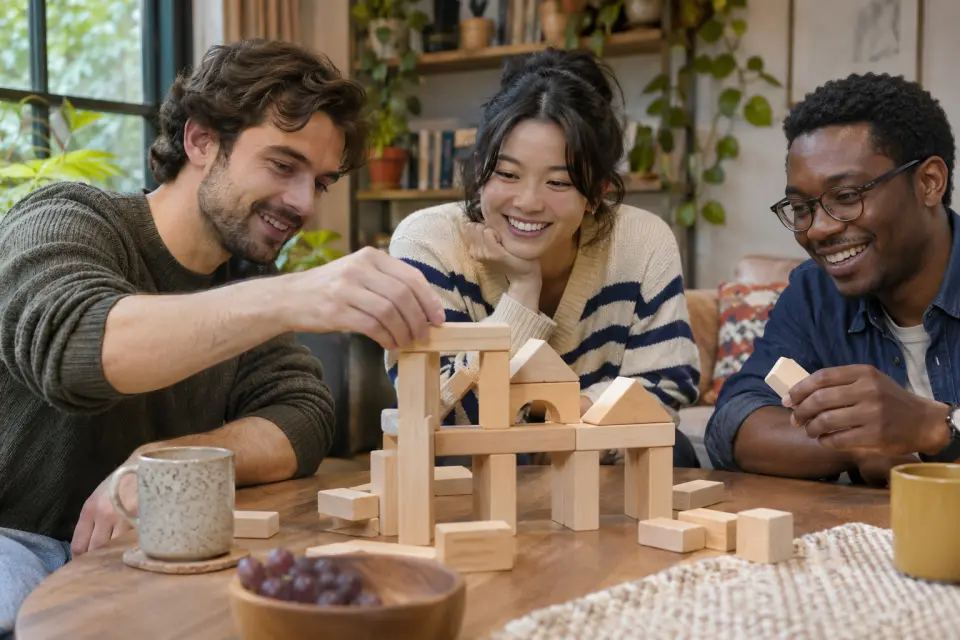
1. Does play have to be funny?
Imagine comparing a concept in a book with an unusual object, or trying a familiar task in a different order. These are activity suggestions, not a standard that requires you to have fun to be mature or healthy. Quiet rest is also a choice.
Wanting to play, enjoying an activity, and producing something creative are different questions. Evidence of one does not establish the others.
2. Separate the research model from practical suggestions
Proyer’s 2017 study examines the 28-item OLIW and four dimensions: Other-directed, Lighthearted, Intellectual, and Whimsical. These are not four categories of people.
Examining what a scale measures differs from testing whether an activity improves grades, work, or relationships. The activities below are editorial ideas, not treatments or programs with guaranteed benefits. Completing an activity does not by itself establish recovery or improved ability.
3. Agree on conditions before starting
| Condition to check | How to adapt the activity |
|---|---|
| Do people want to take part? | Allow opting out or stopping midway. |
| What is allowed? | Agree on limits for time, materials, and space. |
| Who might feel uncomfortable? | Do not use someone’s appearance, mistakes, or sensitive experiences as the joke. |
| Is there an existing responsibility? | Do not replace safety, work duties, or discussion of a conflict with the activity. |
Laughing together does not establish consent to every joke. Ask whether the proposed approach is welcome, and stop if the answer is no. If someone with authority to evaluate others makes the invitation, declining should carry no penalty.
4. Design a small activity using a fictional example
Fictional case: giving study concepts temporary nicknames
Four students agree to give difficult concepts temporary nicknames while reviewing an exam syllabus. They will not nickname people, and they will write the textbook definition alongside each nickname. One person prefers verbal explanation and skips making nicknames.
Afterward, they ask separately whether the activity was enjoyable and whether each person can explain the definition accurately. Laughter alongside an incorrect definition does not establish successful learning. If understanding improves next time, repeated study and exam preparation remain alternative explanations.
On your own, you could list alternative uses for an object or express something you have read as a short analogy. You need not carry out dangerous uses. A time limit need not become a competition; you can stop within a limit you choose.
5. Evaluate the activity, not the person’s worth
Record willingness to participate, comfort, and the actual output separately. “Not enjoyable” is information for changing the activity, not a personality defect. Such notes are personal observations, not an experiment establishing causation.
Optionally, answer the Playfulness Test in two areas: Lightheartedness and Social Playfulness. This is OIYO’s reflection activity, not a research-scale score or diagnosis. It does not separately measure creativity or conflict-resolution ability. Whatever the score, joining the next activity remains your choice.