Dragon year guide: the one imaginary animal in the zodiac
The dragon is the only one of the twelve zodiac animals that does not exist. This page keeps the earthly branch Chen, the checked year pillars (1952, 1964, 1976, 1988, 2000, 2012, 2024), and the traditional triad, six-harmony, clash, harm, and punishment. A birth year is not treated as proof of personality or of the future.
Last reviewed 2026-06-01
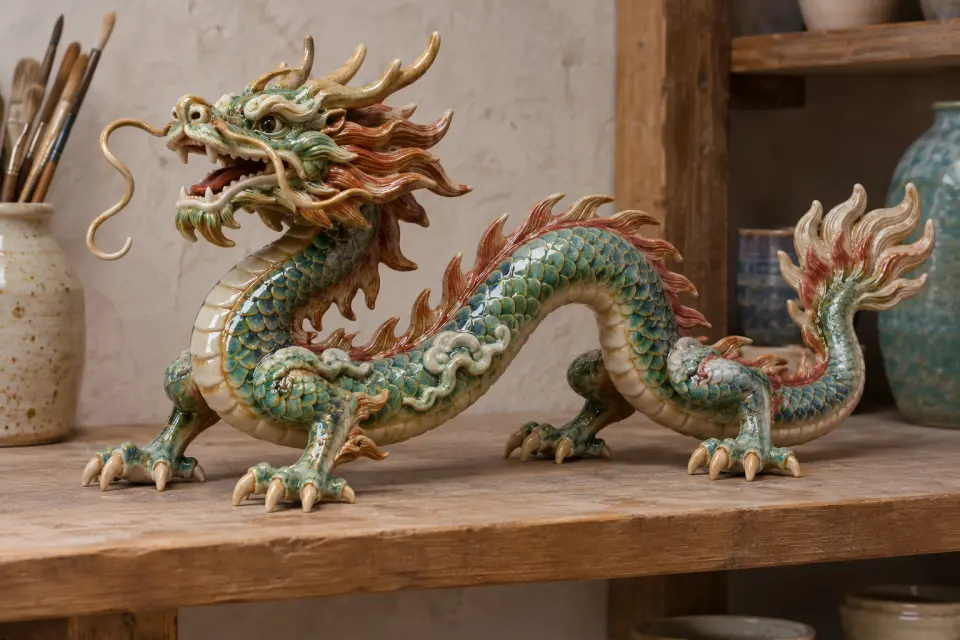
Fifth in the cycle, and the only imaginary animal
The dragon (龍) is the fifth animal of the Chinese zodiac, and the only one of the twelve that does not exist in nature. In Chinese tradition the dragon governs rain and water, and under the Ming and Qing dynasties it served as an emblem of the emperor. That is the history of a symbol. It is not a measured personality of people born in a dragon year.
In some places the dragon year is seen as a lucky time to have a child. Research has documented birth increases in dragon years in Chinese communities such as Taiwan, Hong Kong, and Singapore (Goodkind, 1991). That shows a custom shaping when people chose to have children. It is not evidence that dragon-year people are special.
What the tradition assigns
The rows below are traditional assignments. They are not a personality score.
| Item | Traditional assignment |
|---|---|
| Earthly branch | Chen (辰) |
| Element and yin-yang | Yang earth |
| Direction | Toward the southeast |
| Time | The Chen double-hour, 07:00–09:00 |
Gold, silver, and gray, the numbers 1, 6, and 7, and flowers such as the gentian show up often on modern popular lists. They are not values fixed by the old texts.
Year pillars
The heavenly stem is the year’s element in the sexagenary cycle. The branch stays Chen. Only the stem changes from year to year. This page does not read a personality from that name. The same stem and branch are the notation saju uses for the year pillar. That notation is not evidence of character.
| Year | Year pillar | Element name of the stem |
|---|---|---|
| 1940 | 庚辰 | metal |
| 1952 | 壬辰 | water |
| 1964 | 甲辰 | wood |
| 1976 | 丙辰 | fire |
| 1988 | 戊辰 | earth |
| 2000 | 庚辰 | metal |
| 2012 | 壬辰 | water |
| 2024 | 甲辰 | wood |
| 2036 | 丙辰 | fire |
When the year turns: the everyday zodiac animal changes at Lunar New Year, which falls between January 21 and February 20. The saju year pillar changes at Lichun (Ipchun), the start of spring, around February 4. So if you were born between January and mid-February, you may belong to the previous year’s animal, and if you were born between Lunar New Year and Lichun, the two rules can give different answers. For example, in 2024 Lichun fell on February 4 and Lunar New Year on February 10. Someone born on February 5–9, 2024 has the year pillar Jia-Chen (甲辰) in saju, but by the Lunar New Year rule still belongs to the previous year, Gui-Mao (癸卯), a rabbit year.
The portrait the tradition tells
The tradition often draws a dragon year as someone confident, who thinks in big pictures and does not shy away from standing in front of people. Stories of passion and generosity come with it. A complaint follows: strong pride and stubbornness. A warning follows: high standards that wear out both oneself and others, and a habit of jumping in without a plan when excited. All of that is a traditional portrait. It is not a law for people born in those years.
This page does not turn the imperial emblem into an innate gift for leadership or charisma. The dragon’s majesty is the theme of the symbol.
Love and relationships
The tradition speaks of dragon-year love as warm and expressive. The story is someone who wants to show care in a big way and who reacts strongly when trust is broken. Another story says they value freedom and find too much control stifling. That is neither a diagnosis nor a destiny. As a wished-for partner, the tradition names someone with a world of their own who can stand alongside them. That, too, is the tradition’s story.
Names of traditional relations
This page does not use star ratings or the language of destiny. It keeps the names.
| Name | Pair | Branches |
|---|---|---|
| Triad (三合) | Monkey, rat, dragon | 申子辰 |
| Six-harmony (六合) | Dragon and rooster | 辰酉 |
| Clash (冲) | Dragon and dog | 辰戌 |
| Harm (害) | Dragon and rabbit | 卯辰 |
| Punishment (刑) | Dragon and dragon (self-punishment) | 辰辰 |
Triad and six-harmony are not a higher score, and clash, harm, and punishment are not a lower one. They are the names this scheme has used.
Work
The tradition often names work that means leading from the front or starting something new: founding a business, planning, the stage, or research. It does not say a dragon year will surely reach the top. It is also not proof that those jobs fit best.
Names kept only as birth years
Only the birth year is written. It is not used as evidence of personality. Bruce Lee and John Lennon were both born in the autumn of 1940, a Geng-Chen (庚辰) year.
2026
2026 is Bing-Wu (丙午). Chen (辰) and Wu (午) are not a clash, a harm, or a harmony pair in this scheme. In five-element terms, fire (午) is said to generate earth (辰), but this page does not forecast the year.
Suggestions
- Try leaving one plan for a day and looking at it again before acting. A better result is not guaranteed.
- Try lowering the bar you set for yourself and others by one step.
- A suggestion, not an order: name one thing a person you work with did well, out loud.
Related pages: dragon tool · zodiac compatibility tool · rat year guide · 2026 fire horse year and the 12 animals · saju basics, chapter 1
References
Branch, element, direction, and animal symbol follow the tradition in the works below. Readings of personality, compatibility, and fortune lean on that tradition. There is no scientific evidence that a birth year sets personality or the future.
- 睡虎地秦簡《日書》(3rd century BCE, excavated 1975).
- 王充. 《論衡》〈物勢〉 (1st century).
- Eberhard, W. (1986). A Dictionary of Chinese Symbols: Hidden Symbols in Chinese Life and Thought. Routledge.
- Goodkind, D. M. (1991). Creating new traditions in modern Chinese populations: Aiming for birth in the year of the Dragon. Population and Development Review, 17(4), 663–686.
- National Folk Museum of Korea (2004–2006). 『한국세시풍속사전』. National Folk Museum of Korea.