Capricorn: Saturn, Cardinal Earth, and the Meaning of Responsibility
Read Capricorn as a Western astrological symbol: dates, Saturn, earth and cardinal modality, relationships, work, and the limits of personality claims.
Last reviewed 2026-10-13
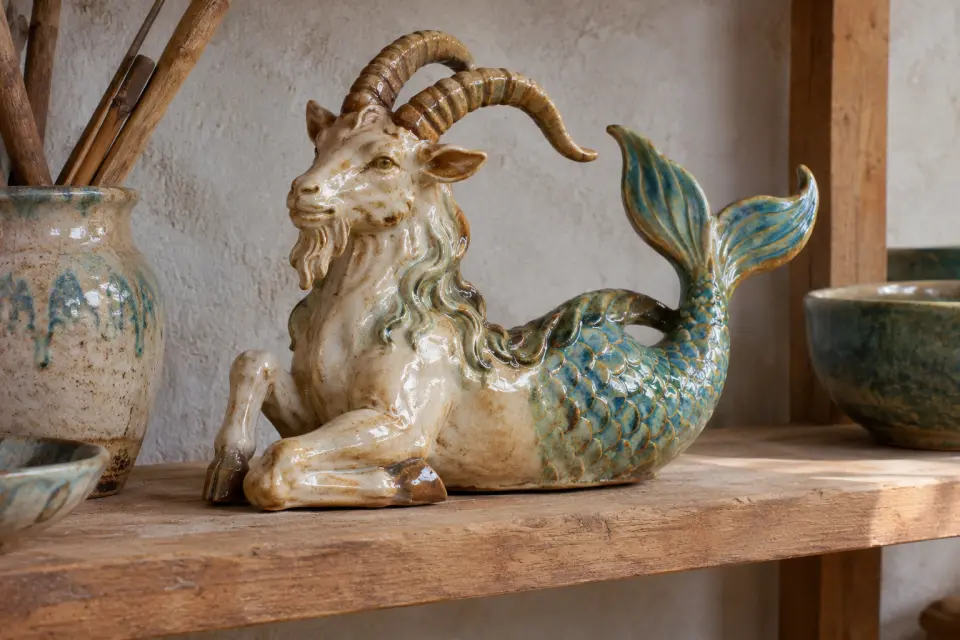
Capricorn (♑) is the sea-goat of Western astrology. Its modern symbolism brings together responsibility, time, material limits, and the wish to build something that lasts. Those themes can be interesting without becoming a verdict about everyone born in late December or January.
This guide explains the tradition, then turns its imagery into questions you can test against your own experience. It is not a personality assessment, a career recommendation, or a forecast. A description that feels familiar is a starting point for reflection, not evidence that a planet caused a trait.
Dates and the symbolic vocabulary
| Term | Meaning in this guide |
|---|---|
| Approximate sun-sign dates | December 22–January 19 |
| Tropical longitude | 270° up to, but not including, 300° |
| Symbol | Sea-goat, ♑ |
| Element | Earth |
| Modality | Cardinal |
| Traditional planetary ruler | Saturn |
The dates are a convenient calendar shorthand, not exact boundaries for every year and time zone. In the tropical zodiac, Capricorn begins at 270° ecliptic longitude, the December solstice point. Near a boundary, the Sun’s position at the actual birth instant matters to the classification. This system divides the ecliptic into twelve equal signs; it is not a map of the unequal astronomical constellations.
The seasonal language comes from a Northern Hemisphere tradition. A December birth in the Southern Hemisphere does not mean a winter birth, and a seasonal metaphor does not establish a psychological effect.
Why Saturn and earth appear together
In Ptolemy’s Tetrabiblos, Book I, chapter 17 assigns Capricorn to Saturn. Chapter 11 places it among the solstitial signs, while chapter 18 groups it with Taurus and Virgo. These passages document an astrological classification; they do not demonstrate that Saturn changes someone’s character.
Modern readings often turn Saturn into the language of boundaries, patience, authority, and responsibility. Earth supplies a practical image: resources, maintenance, and work that must survive contact with reality. Cardinal describes initiation within the symbolic system, rather than a measured amount of leadership.
Together, these ideas produce a useful tension: what is worth beginning, and what will it take to sustain it? The answer can include rest, help, or changing the plan. Responsibility is not the same as carrying every burden alone.
Strengths and difficulties as questions, not labels
The familiar Capricorn portrait praises discipline and warns about rigidity or overwork. Read both sides conditionally. Keeping a promise may be valuable; refusing to renegotiate an impossible promise may not be.
| Symbolic theme | A concrete question |
|---|---|
| Persistence | Am I continuing because the goal still matters, or because stopping feels embarrassing? |
| Responsibility | Which commitments did I actually agree to, and which did I assume without discussion? |
| Standards | What would count as good enough for this task? |
| Long-term planning | What new information would justify changing direction? |
These are editorial reflection prompts, not a validated scale. You do not need to be a Capricorn to use them. If a theme does not fit, leave it out rather than searching for a hidden reason why it must be true.
Relationships: reliability is not mind-reading
In contemporary symbolism, Capricorn is often pictured as showing care through dependable action. That image can open a conversation about what care looks like to each person. It cannot tell you whether a particular partner is loyal, emotionally distant, or ready for commitment.
For example, imagine one person keeps taking practical tasks off the other’s plate, while the other wants more uninterrupted conversation. Neither need is explained by a birthday. Asking “Which actions help you feel supported?” is more useful than assigning one person the role of provider and the other the role of emotional interpreter.
Traditional compatibility discussions connect Capricorn with other earth signs or contrast it with Cancer. Those are relationships between symbols, not success rates for couples. Consent, safety, communication, and the actual history of a relationship take priority over a compatibility label.
Work: translate the image into observable preferences
Building, organizing, and maintaining are common Capricorn motifs. They are not a reason to steer someone toward management, law, finance, or surgery. Real occupations require different skills, qualifications, conditions, and interests.
If the motif appeals to you, try a small task: break a project into milestones, estimate the resources, and review one milestone after a week. Notice whether you enjoyed planning, coordinating people, producing the work, or checking its quality. Those observations offer more useful career information than the sun sign.
Do not infer an MBTI type from Capricorn. INTJ or ISTJ labels sometimes appear beside it in popular writing, but this guide provides no validated conversion between birth charts and questionnaire results. Keep the systems separate.
What a “Saturn return” does and does not mean
Within astrology, a Saturn return means Saturn returns to its natal position. Popular accounts use it as a story about maturity and reassessing commitments. An astronomical cycle and a personal interpretation are different claims: the cycle does not establish a scheduled crisis, promotion, marriage, or transformation.
Similarly, a famous person’s birthday is not evidence for the Capricorn portrait. Selecting successful people after seeing their careers invites a circular story: the success is used to define the sign, then the sign is used to explain the success. We therefore do not use celebrity lists as proof.
One way to use the symbolism
Choose a commitment that matters this month. Write down its purpose, a realistic limit, and a point at which you will reconsider it. Add one example from your own life that supports the “steady builder” image and one that contradicts it. Keeping both examples makes the exercise less likely to become a flattering label.
For another symbolic perspective, you can explore the zodiac compatibility tool. Treat its output as a conversation prompt, not a decision about whom to date or hire.
Sources and limits
- Ptolemy, Tetrabiblos, Book I, chapters 11, 17, and 18: historical classification and planetary assignments, not modern personality evidence.
- Carlson, “A double-blind test of astrology,” Nature (1985): a study of natal-chart personality claims. The publisher page provides the study description; full text requires access. It does not validate the reflection prompts above.
The contemporary metaphors and examples here are interpretive writing, not quotations from Ptolemy or scientifically established descriptions of people.