Ox year guide: the second animal in the race folktale
The ox is the second animal in a popular race folktale. This page keeps the earthly branch Chou, the checked year pillars, and the traditional triad, six-harmony, clash, and harm. A birth year is not treated as proof of personality or of the future.
Last reviewed 2026-06-01
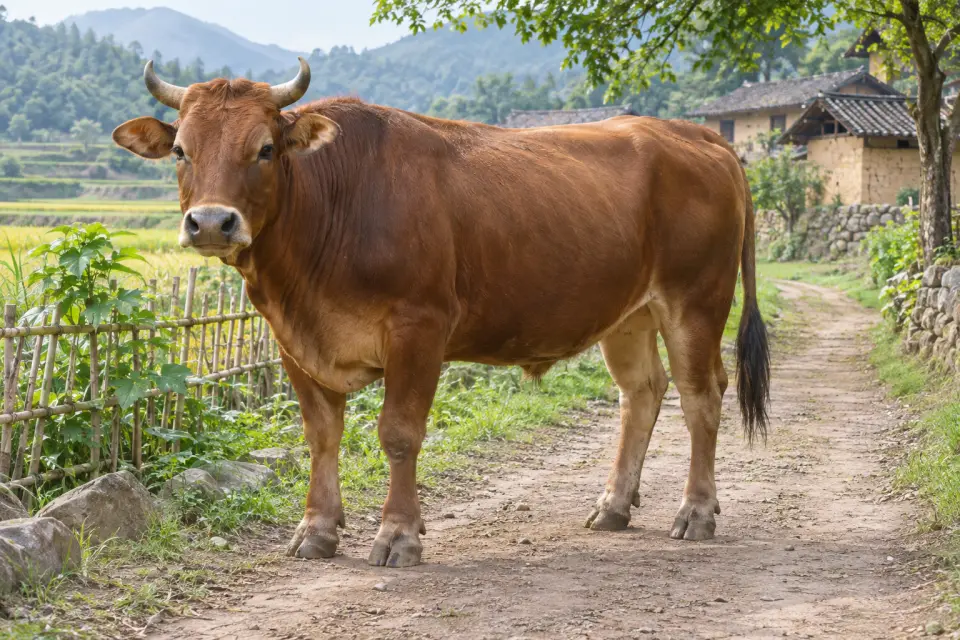
Second in a folktale
In a widely told race folktale, the ox is the second animal. The ox is about to finish ahead, and the rat, which has been riding on its back, jumps off at the finish. That is a folktale. The theme the story keeps returning to is patience. It is not a measured personality of people born in an ox year.
What the tradition assigns
The rows below are traditional assignments. They are not a personality score.
| Item | Traditional assignment |
|---|---|
| Earthly branch | Chou (丑) |
| Element and yin-yang | Yin earth |
| Direction | Northeast in the later-heaven layout |
| Time | The Chou double-hour, 01:00–03:00 |
White, yellow, and green, the numbers 1 and 4, and the tulip and the peach blossom are names that show up often on modern popular lists. They are not values fixed by the old texts.
Year pillars
The heavenly stem is the year’s element in the sexagenary cycle. The branch stays Chou. Only the stem changes from year to year. This page does not read a personality from that name. The same stem and branch are the notation saju uses for the year pillar. That notation is not evidence of character.
| Year | Year pillar | Element name of the stem |
|---|---|---|
| 1937 | 丁丑 | fire |
| 1949 | 己丑 | earth |
| 1961 | 辛丑 | metal |
| 1973 | 癸丑 | water |
| 1985 | 乙丑 | wood |
| 1997 | 丁丑 | fire |
| 2009 | 己丑 | earth |
| 2021 | 辛丑 | metal |
The portrait the tradition tells
The tradition often draws an ox year as someone who continues the work rather than the speech, who tries to keep a promise once taken, and who looks at a near goal in a practical way. It also writes a pillar that finishes what was taken on, and a stubbornness that receives change slowly. A complaint follows: the inside is hard to move into words. A warning follows: a line, once crossed, is remembered for a long time. All of that is a traditional portrait. It is not a law for people born in those years.
Patience stays as the folktale’s theme. This page does not turn it into a crude power of holding on.
Love and relationships
The tradition speaks of ox-year love as serious and long. The story is a slow building of trust, and care shown by the steadiness of ordinary days rather than by a large event. There is also a warning that broken trust is hard to come back from. That is neither a diagnosis nor a destiny. As a wished-for partner, the tradition names someone who can hear a plain way of speaking and who wants steadiness more than swing. That, too, is the tradition’s story.
Names of traditional relations
This page does not use star ratings or the language of destiny. It keeps the names.
| Name | Pair | Branches |
|---|---|---|
| Triad (三合) | Snake, rooster, ox | 巳酉丑 |
| Six-harmony (六合) | Rat and ox | 子丑 |
| Clash (冲) | Ox and goat | 丑未 |
| Harm (害) | Ox and horse | 丑午 |
Triad and six-harmony are not a higher score, and clash and harm are not a lower one. They are the names this scheme has used.
Work
The tradition often names steady crafts: cooking, a hand craft, or a post one keeps. It does not claim an innate medical talent, money that follows from the earth element, or a unique result. It is also not proof that those jobs fit best.
Names kept only as birth years
Only the birth year is written. It is not used as evidence of personality. Park Chan-ho was born in 1973, Barack Obama in 1961, Napoleon in 1769, and Charlie Chaplin in 1889.
2026
2026 is Bing-Wu (丙午). Chou (丑) and Wu (午) are not a clash. In this scheme they are a harm pair. This page does not forecast the year.
Suggestions
- Try delaying a stubborn line by a little. There is no guarantee that more possibilities open.
- Try one sentence about what is inside. If it is not said, the other person has a hard time knowing it.
- A suggestion, not an order: do not refuse change as a whole. Changing slowly is all right.
Related pages: ox tool · saju basics, chapter 1
References
Branch, element, direction, and animal symbol follow the tradition in the works below. An animal-year reading is tradition. It is not evidence that a birth year sets personality or the future.
- 睡虎地秦簡《日書》
- 王充《論衡·物勢》
- Eberhard, W. (1986). A Dictionary of Chinese Symbols. Routledge.
- National Folk Museum of Korea, 『한국세시풍속사전』