Rooster year guide: the tenth animal and the earthly branch You
The rooster is the tenth animal of the Chinese zodiac. This page covers the earthly branch You (酉), the checked year pillars, when a rooster year begins (Lunar New Year or Ipchun), and the traditional triad, six-harmony, clash, and harm. A birth year is not treated as proof of personality or of the future.
Last reviewed 2026-06-01
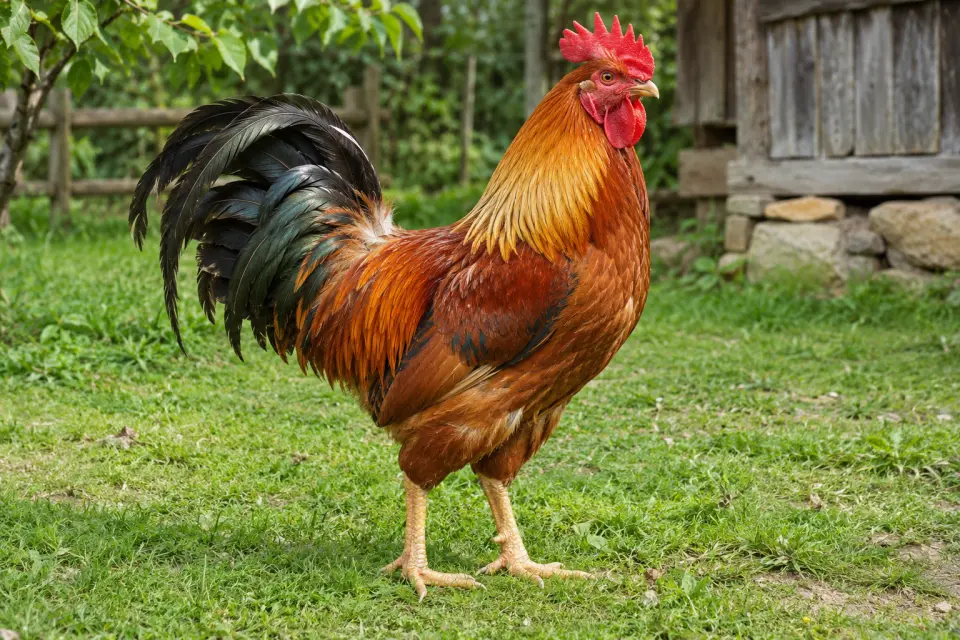
The tenth animal, the one that calls the dawn
The rooster is the tenth animal of the twelve, and its earthly branch is You (酉). In East Asia the rooster crows at every dawn, so it often stands for keeping time and keeping one’s word. The Han-dynasty Hanshi Waizhuan (韓詩外傳) tells of the rooster’s five virtues: culture, martial spirit, courage, kindness, and trustworthiness. That is symbolism. It is not a measured personality of people born in a rooster year.
What the tradition assigns
The rows below are traditional assignments. They are not a personality score.
| Item | Traditional assignment |
|---|---|
| Earthly branch | You (酉) |
| Element and yin-yang | Yin metal |
| Direction | West |
| Time | The You double-hour, 17:00–19:00 |
Gold, brown, and yellow, the numbers 5, 7, and 8, and the gladiolus and the impatiens show up often on modern popular lists. They are not values fixed by the old texts.
Year pillars
The heavenly stem is the element name the year carries in the sexagenary cycle. The branch stays You; only the stem changes. This page does not read a personality from that name. The same stem and branch are the notation saju uses for the year pillar. That notation is not evidence of character.
| Year | Year pillar | Element name of the stem |
|---|---|---|
| 1945 | 乙酉 | wood |
| 1957 | 丁酉 | fire |
| 1969 | 己酉 | earth |
| 1981 | 辛酉 | metal |
| 1993 | 癸酉 | water |
| 2005 | 乙酉 | wood |
| 2017 | 丁酉 | fire |
| 2029 | 己酉 | earth |
When the year changes: these years do not start on January 1. The popular zodiac usually counts from Lunar New Year, while the saju year pillar changes at Ipchun (the start of spring, around February 4). For example, the 2017 Ding-You year began on January 28 by Lunar New Year. If you were born in January or early February, your animal may be the monkey (申) of the year before.
In a Xin-You (辛酉) year both the stem and the branch carry the metal name. That is a feature of the notation. It is not evidence that people born that year are more meticulous.
The portrait the tradition tells
The tradition often draws a rooster year as someone who keeps time and promises, who looks after the details, and who says what they think directly instead of hinting. It adds a steady diligence that finishes the job, and a neat way of managing appearance and schedule. The same portrait warns that high standards can turn into strictness toward oneself and others, that this person may not change their way easily, and that too much thinking can delay a decision. All of that is a traditional portrait. It is not a law for people born in those years.
Love and relationships
The tradition speaks of rooster-year love as sincere and clear about its standards. The story is someone who does not neglect even a small promise, and who shows care through steady action more than through words. There is also a warning that pointing out a partner’s flaws can come out as a kind of affection and still hurt. That is neither a diagnosis nor a destiny. As a wished-for partner, the tradition names someone who can hear a direct way of speaking without misunderstanding it, and who does not take promises lightly. That, too, is the tradition’s story.
Names of traditional relations
This page does not use star ratings or the language of destiny. It keeps the names.
| Name | Pair | Branches |
|---|---|---|
| Triad (三合) | Snake, rooster, ox | 巳酉丑 |
| Six-harmony (六合) | Dragon and rooster | 辰酉 |
| Clash (冲) | Rabbit and rooster | 卯酉 |
| Harm (害) | Rooster and dog | 酉戌 |
Triad and six-harmony are not a higher score, and clash and harm are not a lower one. They are the names this scheme has used.
Work
The tradition often names work where accuracy and care show: accounting, editing and proofreading, record-keeping and inspection. It does not claim an innate medical talent, money that follows from the metal element, or a unique result. It is also not proof that those jobs fit best.
Names kept only as birth years
Only the birth year is written. It is not used as evidence of personality. Eric Clapton was born in March 1945 (乙酉), and Britney Spears in December 1981 (辛酉). Both were born after both Lunar New Year and Ipchun of that year.
2026
2026 is Bing-Wu (丙午). You (酉) and Wu (午) are not in any of the triad, six-harmony, clash, or harm pairs above. This page does not forecast the year.
Suggestions
- Try not to ask others to meet your own standard exactly. There is no guarantee the relationship improves.
- Try starting before things are perfect. There is still time to fix things after you begin.
- A suggestion, not an order: before pointing something out, say one sentence of thanks first. The same words can land differently.
Related pages: rooster tool · 2026 fire horse year and the 12 animals · saju major and annual luck cycles · saju basics, chapter 1
References
Branch, element, direction, and animal symbol follow the tradition in the works below. Readings of personality, compatibility, and fortune rest on that tradition, and there is no scientific evidence that a birth year sets personality or the future.
- 睡虎地秦簡《日書》(3rd century BCE, excavated 1975).
- 王充. 《論衡》〈物勢〉 (1st century).
- 韓嬰. 《韓詩外傳》 卷二 (2nd century BCE).
- Eberhard, W. (1986). A Dictionary of Chinese Symbols: Hidden Symbols in Chinese Life and Thought. Routledge.
- National Folk Museum of Korea (2004–2006). 『한국세시풍속사전』. National Folk Museum of Korea.