Snake year guide: the sixth animal and the earthly branch Si
The snake is the sixth animal of the Chinese zodiac. This page covers the earthly branch Si (巳), the checked year pillars, when a snake year begins (Lunar New Year or Ipchun), and the traditional triad, six-harmony, clash, and harm. A birth year is not treated as proof of personality or of the future.
Last reviewed 2026-06-01
The sixth animal
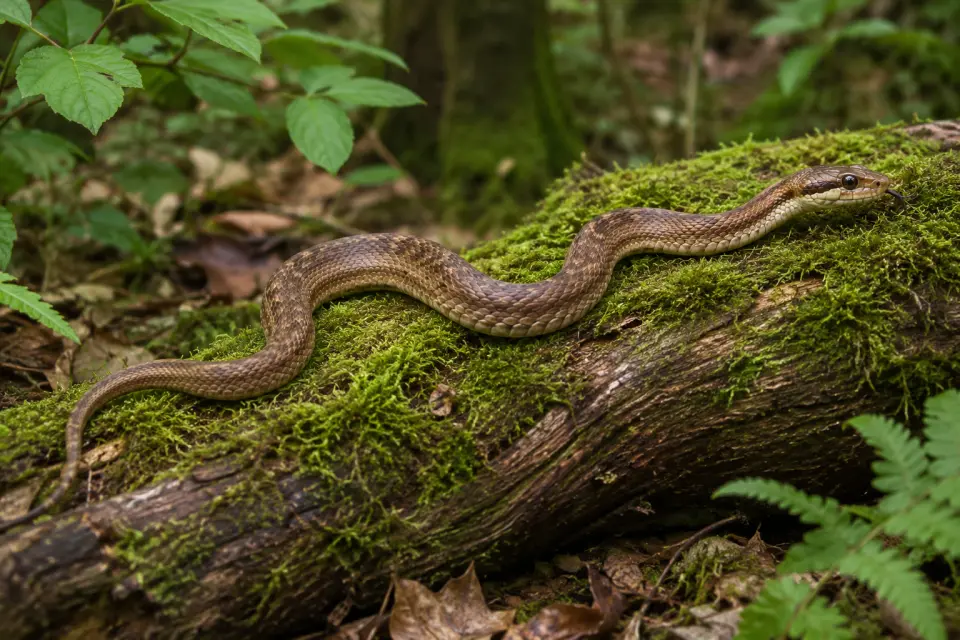
The snake is the sixth animal of the twelve, and its earthly branch is Si (巳). In many stories, East and West, the snake sheds its skin, so it often stands for change, renewal, wisdom, or secrets. That is symbolism. It is not a measured personality of people born in a snake year.
What the tradition assigns
The rows below are traditional assignments. They are not a personality score.
| Item | Traditional assignment |
|---|---|
| Earthly branch | Si (巳) |
| Element and yin-yang | Fire. By branch order it is yin, but saju practice often treats it as yang fire because of the Bing (丙) fire it holds |
| Direction | South-southeast (the Si sector of the 24 directions) |
| Time | The Si double-hour, 09:00–11:00 |
Red, light yellow, and black, the numbers 2, 8, and 9, and the orchid and the cactus show up often on modern popular lists. They are not values fixed by the old texts.
Year pillars
The heavenly stem is the element name the year carries in the sexagenary cycle. The branch stays Si; only the stem changes. This page does not read a personality from that name. The same stem and branch are the notation saju uses for the year pillar. That notation is not evidence of character.
| Year | Year pillar | Element name of the stem |
|---|---|---|
| 1941 | 辛巳 | metal |
| 1953 | 癸巳 | water |
| 1965 | 乙巳 | wood |
| 1977 | 丁巳 | fire |
| 1989 | 己巳 | earth |
| 2001 | 辛巳 | metal |
| 2013 | 癸巳 | water |
| 2025 | 乙巳 | wood |
When the year changes: these years do not start on January 1. The popular zodiac usually counts from Lunar New Year, while the saju year pillar changes at Ipchun (the start of spring, around February 4). For example, the 2025 Yi-Si year began on January 29 by Lunar New Year and on February 3 by Ipchun. If you were born in January or early February, your animal may be the dragon (辰) of the year before.
The portrait the tradition tells
The tradition often draws a snake year as someone of few words and deep thought, who looks beneath the surface first, and who does not waver easily once a decision is made. A good eye for beauty is often added. The same portrait warns that this person may be slow to open up, may keep plans and feelings hidden in a way that frustrates others, and may remember a hurt for a long time. All of that is a traditional portrait. It is not a law for people born in those years.
Love and relationships
The tradition speaks of snake-year love as careful and deep. The story is someone who watches for a long time before approaching, and who shows thoughtful attention once trust has grown. There are also warnings about possessiveness and jealousy that is not shown. That is neither a diagnosis nor a destiny. As a wished-for partner, the tradition names someone who respects time alone and a private inner world. That, too, is the tradition’s story.
Names of traditional relations
This page does not use star ratings or the language of destiny. It keeps the names.
| Name | Pair | Branches |
|---|---|---|
| Triad (三合) | Snake, rooster, ox | 巳酉丑 |
| Six-harmony (六合) | Snake and monkey | 巳申 |
| Clash (冲) | Snake and pig | 巳亥 |
| Harm (害) | Snake and tiger | 寅巳 |
Triad and six-harmony are not a higher score, and clash and harm are not a lower one. They are the names this scheme has used.
Work
The tradition often names work that goes deep: research, writing, the arts, long analysis. It does not claim an intuition for markets, an innate talent for medicine or psychology, or a unique result. It is also not proof that those jobs fit best.
Names kept only as birth years
Only the birth year is written. It is not used as evidence of personality. Yi Sun-sin was born in 1545 (乙巳), Pablo Picasso in 1881 (辛巳), and Audrey Hepburn in 1929 (己巳). All three were born after both Lunar New Year and Ipchun of that year.
2026
2026 is Bing-Wu (丙午). Si (巳) and Wu (午) are neither a clash nor a harm pair. In this scheme Si, Wu, and Wei (巳午未) form the directional group of southern fire. This page does not forecast the year.
Suggestions
- Try offering a small amount of trust first instead of doubting everything. There is no guarantee the relationship improves.
- Try one sentence about what you feel inside. If it is not said, the other person has a hard time knowing it.
- A suggestion, not an order: loosen an old hurt little by little. If it feels heavy, talking with someone you trust or a counselor can help.
Related pages: snake tool · 2026 fire horse year and the 12 animals · saju major and annual luck cycles · saju basics, chapter 1
References
Branch, element, direction, and animal symbol follow the tradition in the works below. Readings of personality, compatibility, and fortune rest on that tradition, and there is no scientific evidence that a birth year sets personality or the future.
- 睡虎地秦簡《日書》(3rd century BCE, excavated 1975).
- 王充. 《論衡》〈物勢〉 (1st century).
- Eberhard, W. (1986). A Dictionary of Chinese Symbols: Hidden Symbols in Chinese Life and Thought. Routledge.
- National Folk Museum of Korea (2004–2006). 『한국세시풍속사전』. National Folk Museum of Korea.