Tiger year guide: the third animal in the race folktale
The tiger is the third animal in a popular race folktale. This page covers the earthly branch Yin, the checked year pillars, when a zodiac year actually starts, and the traditional triad, six-harmony, clash, and harm. A birth year is not treated as proof of personality or of the future.
Last reviewed 2026-06-01
Third in a folktale
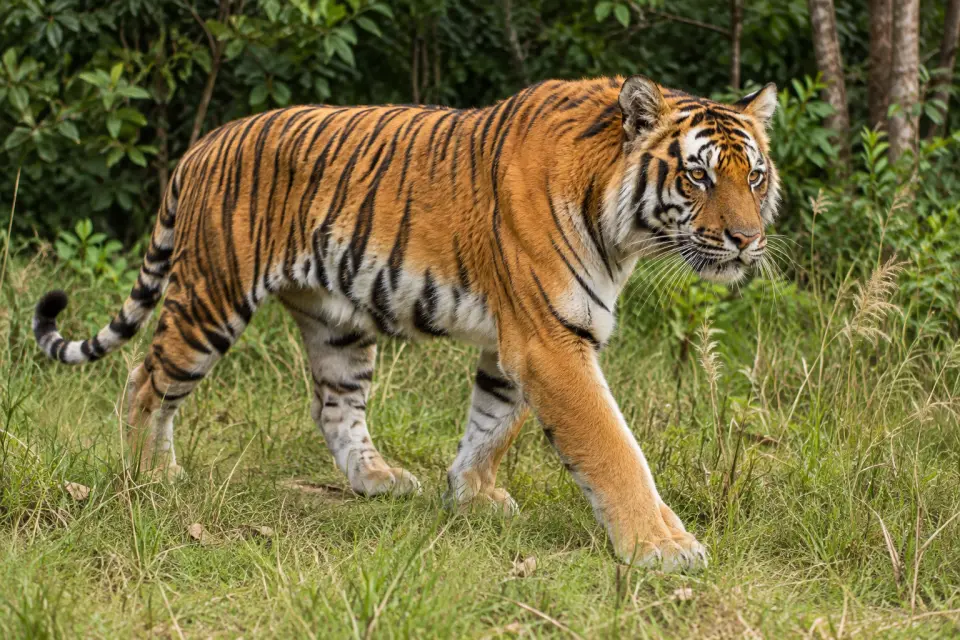
In the widely told zodiac race folktale, the tiger is the third animal. Across East Asian folklore the tiger often appears as a guardian of the mountains and a symbol that drives off evil spirits, and in Korea people once hung tiger pictures at the new year. These are stories about symbols and customs. They are not a measured personality of people born in a tiger year.
What the tradition assigns
The rows below are traditional assignments. They are not a personality score.
| Item | Traditional assignment |
|---|---|
| Earthly branch | Yin (寅) |
| Element and yin-yang | Yang wood |
| Direction | East-northeast on the twelve-branch compass; east in the seasonal grouping (寅卯辰) |
| Time | The Yin double-hour, 03:00–05:00 |
Blue, grey, and orange, the numbers 1, 3, and 4, and the yellow lily show up often on modern popular lists. They are not values fixed by the old texts.
When a tiger year begins
A zodiac year does not change on 1 January. In everyday use the animal usually changes at Lunar New Year, while saju (Four Pillars) practice uses Lichun, the start of spring (usually around 4 February) as the boundary. So someone born in January 1986 is an ox (乙丑) under both conventions, not a tiger. If you were born between Lichun and Lunar New Year, the answer can depend on which convention you follow.
Year pillars
The heavenly stem is the element name the sexagenary cycle gives that year. The branch stays Yin; only the stem changes. This page does not read personality from that name. The same stem and branch are also the notation saju uses for the year pillar. That notation is not evidence of character.
| Year | Year pillar | Element name of the stem |
|---|---|---|
| 1938 | 戊寅 | earth |
| 1950 | 庚寅 | metal |
| 1962 | 壬寅 | water |
| 1974 | 甲寅 | wood |
| 1986 | 丙寅 | fire |
| 1998 | 戊寅 | earth |
| 2010 | 庚寅 | metal |
| 2022 | 壬寅 | water |
The tradition itself does not rank any of these years as 「the strongest tiger」.
The portrait the tradition tells
The tradition often draws a tiger year as someone who steps to the front, who cannot let unfairness pass, and who pours their strength into whatever they have decided on. On the other side come the complaints: acting first and thinking later, a strong will and stronger pride, and a restlessness that finds it hard to stay in one place. All of that is a traditional portrait. It is not a law for people born in those years.
Love and relationships
The tradition describes tiger-year love as direct and warm. When their heart moves, they say so plainly and try to protect the other person. The matching warning is that they may try to steer a partner their own way, which can lead to friction. That is neither a diagnosis nor a destiny. As a wished-for partner, the tradition names someone who respects that energy and still speaks their own mind clearly. That, too, is the tradition’s story.
Names of traditional relations
This page does not use star ratings or the language of destiny. It keeps the names.
| Name | Pair | Branches |
|---|---|---|
| Triad (三合) | Tiger, horse, dog | 寅午戌 |
| Six-harmony (六合) | Tiger and pig | 寅亥 |
| Clash (冲) | Tiger and monkey | 寅申 |
| Harm (害) | Tiger and snake | 寅巳 |
Triad and six-harmony are not a higher score, and clash and harm are not a lower one. They are the names this scheme has used.
Work
The tradition often links the tiger with work that leads from the front, work that faces physical risk, and work that stands up against unfairness. That is not proof that those jobs fit best, and this page has no data showing that any sign is more common in any profession.
Names kept only as birth years
Only the birth year is written. It is not used as evidence of personality. Ludwig van Beethoven was born in 1770, Charles de Gaulle in 1890, Tom Cruise in 1962, and Lady Gaga in 1986.
2026
2026 is Bing-Wu (丙午). Yin (寅) and Wu (午) are branches of the same triad, 寅午戌. This page does not forecast the year.
Suggestions
- Try pausing for a moment before a decision. That does not mean a quick decision is always a bad one.
- Try handing off just one task you would normally carry alone.
- Deciding ahead of time where to spend your energy and where to hold back may help you avoid wearing yourself out.
Related pages: tiger tool · 2026 fire horse year and the 12 animals · the 60 day pillars in saju · saju basics, chapter 1
References
Branch, element, direction, and animal symbol follow the tradition in the works below. Readings of personality, compatibility, and fortune are interpretations that lean on this tradition. There is no scientific evidence that a birth year sets personality or the future.
- 睡虎地秦簡《日書》 (3rd century BCE, excavated 1975).
- 王充. 《論衡》〈物勢〉 (1st century).
- Eberhard, W. (1986). A Dictionary of Chinese Symbols: Hidden Symbols in Chinese Life and Thought. Routledge.
- National Folk Museum of Korea (2004–2006). 『한국세시풍속사전』. National Folk Museum of Korea.