April Birth Flowers: Daisy and Sweet Pea
English lists give April the daisy and the sweet pea. This page separates the plants, the old flower-book meanings, and the later glosses, notes that sweet pea seeds are not food, and does not read people born in April.
Last reviewed 2026-04-01
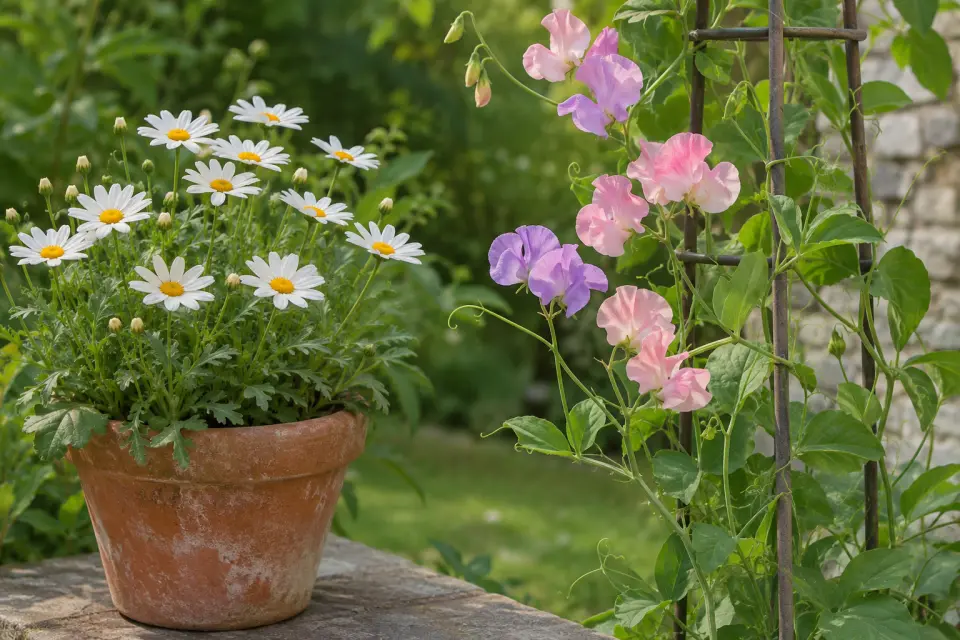
In most English lists, the April birth flowers are the daisy and the sweet pea. A birth flower is a symbol tied to a month. It is not a portrait of people born in April.
Hartmann et al. (2006) did not find that birth date predicts personality. Controlled tests of birth-date or birth-chart personality prediction did not find an effect (Carlson, 1985; Hartmann et al., 2006). Those studies are about Western astrology and birth date. They are not a trial of these flowers.
Daisy (Bellis perennis)
The plant
Bellis perennis is the common or lawn daisy of Europe: a small plant with white, sometimes pink-tipped rays around a yellow center. The flower heads open in daylight and close in the evening and in dull weather. In everyday English, “daisy” is also used for larger relatives such as the oxeye daisy (Leucanthemum vulgare), so lists and pictures do not always mean the same plant.
The day’s eye
The English name comes from the Old English dæges ēage, “day’s eye”, which matches the way the flower opens and closes with the light. Chaucer plays on this in the prologue to The Legend of Good Women, where he calls the daisy the “eye of the day”.
He loves me, he loves me not
Pulling the petals off one by one while saying “he loves me, he loves me not” is a well-known game. In French it is called effeuiller la marguerite, and it is often played with the larger oxeye daisy. How old the game is, and where it began, is not well documented, so this page does not give it a date. It is a game of chance, not a way to learn what someone feels.
Freya and the daisy
Many websites say the daisy was sacred to the Norse goddess Freya. The surviving Old Norse poems and sagas do not describe this, and it appears to be a modern claim rather than a recorded belief.
Meanings on the lists
In Kate Greenaway’s Language of Flowers (1884), the daisy stands for innocence. Purity, cheerfulness, new beginnings, and loyal love are later popular glosses on the same idea. Japanese hanakotoba lists often give the daisy (ヒナギク) meanings such as innocence (無邪気) and peace. Those lists vary from one publisher to another.
Sweet Pea (Lathyrus odoratus)
The plant
The sweet pea is a climbing annual in the pea family, grown for its scented flowers in white, pink, red, and purple. It is native to Sicily, southern Italy, and nearby islands. Francesco Cupani, a Sicilian friar and botanist, sent seeds to England at the end of the 17th century, and this is usually given as the start of its cultivation in northern Europe.
A Victorian and Edwardian favorite
In the late 19th century the Scottish breeder Henry Eckford raised many larger-flowered varieties. Around 1901 the ruffled Spencer type appeared at Althorp in England, and in the Edwardian years the sweet pea became a popular show flower with its own competitions.
Meanings on the lists
In Kate Greenaway’s 1884 list, the sweet pea means departure. Other lists give delicate or blissful pleasure. The idea that a sweet pea says “thank you for a lovely time” is a modern gift-list gloss built on those two meanings, not an old definition. Japanese hanakotoba lists often give the sweet pea (スイートピー) meanings such as a new start (門出) and tender memories.
Safety: sweet peas are not edible peas. The seeds and pods contain compounds linked to a condition called lathyrism when eaten in quantity, and the ASPCA lists the plant as toxic to cats, dogs, and horses. Keep seeds away from children and pets. If someone has eaten them, call a poison center or a doctor.
What the month symbol does not do
On these lists, the daisy and the sweet pea stand for the month of April. They do not say who an April-born person is, and they do not promise love, luck, or an easy goodbye. The plants are traditional pictures for a spring month, each with its own history, and that history is worth keeping apart from the meanings later lists have added.
References
- Carlson, S. (1985). A double-blind test of astrology. Nature, 318, 419–425.
- Hartmann, P., Reuter, M., & Nyborg, H. (2006). The relationship between date of birth and individual differences in personality and general intelligence: A large-scale study. Personality and Individual Differences, 40(7), 1349–1362.
- Chaucer, Geoffrey. Prologue to The Legend of Good Women (the daisy as “eye of the day”).
- Greenaway, Kate. Language of Flowers (1884).
- ASPCA Animal Poison Control: toxic and non-toxic plants