February Birth Flowers: Violet and Primrose
English lists usually give February the violet and the primrose. This page separates the plants, the myths, and the later flower meanings, notes what is safe to touch or eat, and does not read people born in February.
Last reviewed 2026-04-01
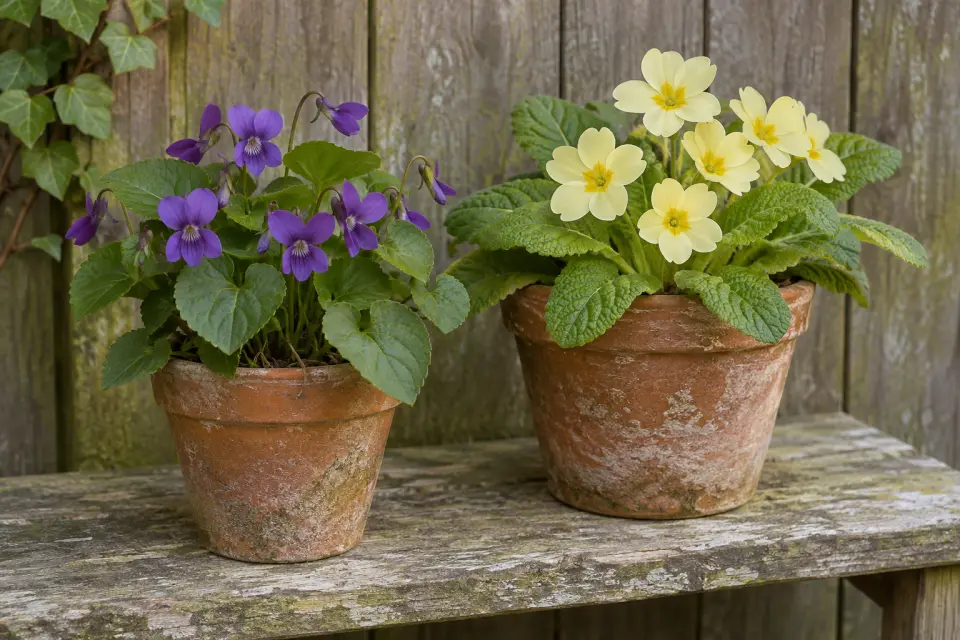
In many English lists, the February birth flowers are the violet and the primrose. Both are small, low plants that flower at the turn from winter to spring, and some lists name the iris instead. A birth flower is a symbol tied to a month. It is not a portrait of people born in February.
Hartmann et al. (2006) did not find that birth date predicts personality. Controlled tests of birth-date or birth-chart personality prediction did not find an effect (Carlson, 1985; Hartmann et al., 2006). Those studies are about Western astrology and birth date. They are not a trial of these flowers.
Violet (Viola odorata)
The plant
Viola odorata is the sweet violet, native to Europe and western Asia and now naturalized in many other places. It grows close to the ground, spreads by runners, and opens small scented flowers, usually purple, sometimes white, in late winter and early spring. The African violet sold as a houseplant belongs to a different family and is not a true violet.
Io and the Greek name
In book 1 of Ovid’s Metamorphoses, Jupiter turns Io into a white heifer to hide her from Juno. Later flower books add that he made violets grow so she had something sweet to eat, and that the Greek word for violet, ion, comes from her name. That link is a folk etymology repeated by later writers. It is not part of Ovid’s telling.
Napoleon’s flower
Napoleon’s supporters nicknamed him Caporal la Violette, Corporal Violet, and the violet became a Bonapartist emblem around his return from Elba in March 1815. Wearing violets could signal loyalty to him. Stories about violets he is said to have kept from Joséphine’s grave are often told, but the details vary from one telling to the next.
Meanings on the lists
In Kate Greenaway’s Language of Flowers (1884), the blue violet stands for faithfulness, the sweet violet for modesty, and the yellow violet for rural happiness. Watchfulness, which some modern tables give to the blue violet, belongs in Greenaway’s list to dame’s violet, a different plant (Hesperis matronalis). Faithful love, devotion, and humility are the readings most modern gift lists use. The humility reading draws on the plant’s habit of flowering low and quietly, and it works as an image, not as a fact about the plant.
Food, old herbals, and safety: sweet violet flowers are candied as a sweet, and Toulouse in France is known for them. Violet syrup appears in old European herbals. That history is not evidence that violet treats anything, so please ask a doctor or pharmacist before using any plant as a remedy. Only eat flowers you have identified with certainty and that have not been sprayed, and do not confuse sweet violets with African violets or other houseplants.
Primrose (Primula vulgaris)
The plant
Primula vulgaris is the common primrose of western and southern Europe. It opens pale yellow flowers, one to each stalk, in early spring, often in woods and on banks while the ground is still cold. The bright garden primroses and polyanthus sold in many colors are mostly hybrids.
The name
The English name comes from medieval Latin prima rosa, first rose. The genus name Primula is a diminutive of Latin primus, first, so it means something like little first one. Both names point to how early the plant flowers.
Meanings on the lists
In Greenaway’s 1884 list, the primrose stands for early youth. The evening primrose, a different plant (Oenothera), is given as inconstancy. Young love and hope are common modern readings. The line I can’t live without you appears on many modern lists, but its origin is unclear and it is not in Greenaway’s list.
In Britain, 19 April is Primrose Day, the anniversary of the death of Prime Minister Benjamin Disraeli in 1881. Queen Victoria sent primroses to his funeral, and the Primrose League, founded in 1883, took the flower as its badge.
Folklore and modern claims
Irish and British folklore records the custom of laying primroses on doorsteps on May Eve to keep fairies away from the house. That is a recorded belief, not a tested effect.
Some websites say the primrose was sacred to Freya. Those pages usually give no Old Norse source for the link, so it is best read as a modern claim.
Japanese hanakotoba lists often give first love and hope for sakurasō. That name usually refers to Primula sieboldii, an East Asian species, not the European primrose.
Safety: some primulas can cause an itchy skin rash, and the house primrose, Primula obconica, is a well-known cause of allergic contact dermatitis. If your skin reacts after handling primulas, wear gloves, and see a doctor if a rash does not settle.
What the month symbol does not do
February also holds St Valentine’s Day, so lists often lean on the love meanings of both flowers. On these lists, the violet and the primrose stand for the month of February. They do not say who a February-born person is, and they do not promise love, luck, or calm. The plants are traditional pictures for the end of winter, each with its own history, and that history is worth keeping apart from the meanings later lists have added.
References
- Carlson, S. (1985). A double-blind test of astrology. Nature, 318, 419–425.
- Hartmann, P., Reuter, M., & Nyborg, H. (2006). The relationship between date of birth and individual differences in personality and general intelligence: A large-scale study. Personality and Individual Differences, 40(7), 1349–1362.
- Ovid, Metamorphoses, book 1 (Io).
- Greenaway, Kate. Language of Flowers (1884).