January Birth Flowers: Carnation and Snowdrop
English lists give January the carnation and the snowdrop. This page separates the plants, the old flower-language meanings, and the later legends, notes what is toxic, and does not read people born in January.
Last reviewed 2026-04-01
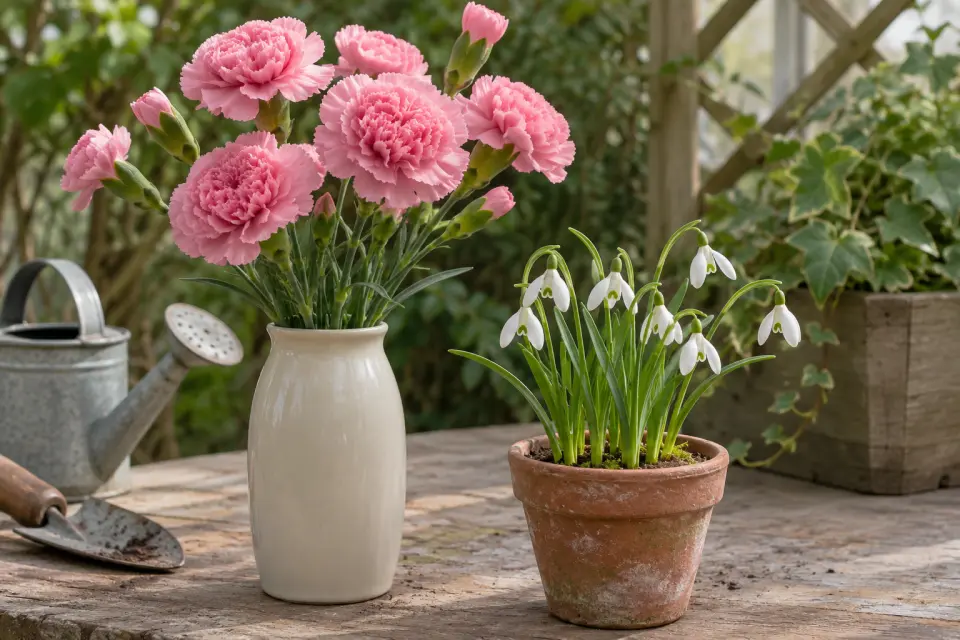
In most English lists, the January birth flowers are the carnation and the snowdrop. One is a florist’s flower sold all year, and the other is one of the first bulbs to bloom in late winter. A birth flower is a symbol tied to a month. It is not a portrait of people born in January.
Hartmann et al. (2006) did not find that birth date predicts personality. Controlled tests of birth-date or birth-chart personality prediction did not find an effect (Carlson, 1985; Hartmann et al., 2006). Those studies are about Western astrology and birth date. They are not a trial of these flowers.
Carnation (Dianthus caryophyllus)
The plant
The carnation is a Mediterranean species of Dianthus, the genus of pinks and sweet williams. It has been grown in European gardens for centuries, and modern florist carnations come in almost every color. The genus name Dianthus was given by the Greek botanist Theophrastus and is usually explained as dios (of Zeus, or divine) and anthos (flower). Where the English word carnation comes from is debated: some trace it to coronation, for the garlands it was used in, and others to the Latin carnis, flesh, for its pink color.
Mother’s Day and Parents’ Day
The carnation’s best-known modern meaning comes from a 20th-century custom. Anna Jarvis, who campaigned for Mother’s Day in the United States, handed out white carnations, her late mother’s favorite flower, at a 1908 memorial service in Grafton, West Virginia. Carnations became the Mother’s Day flower in the US and later in Japan, and in Korea they are given on Parents’ Day (8 May).
Color meanings on the lists
Modern gift lists usually give the carnation’s colors these meanings:
| Color | Meaning on modern lists |
|---|---|
| Red | Love, admiration |
| Pink | Gratitude, a mother’s love |
| White | Pure love, remembrance |
| Purple | Capriciousness |
| Yellow | Disappointment, rejection |
| Striped | Refusal |
The negative colors are the oldest part of this table. In Kate Greenaway’s Language of Flowers (1884), a yellow carnation means disdain and a striped one means refusal. The other colors vary from list to list, so treat the table as a convention, not a rule.
The legend of Mary’s tears
Many gift guides say carnations first grew where the Virgin Mary’s tears fell as she watched Jesus carry the cross. The story does not come from the Bible, and we have not found an early written source for it. It is a devotional legend that explains the flower’s link with a mother’s love, not a historical account.
Safety: carnations are not a food plant for pets. The ASPCA lists the carnation as toxic to cats and dogs, usually with mild stomach upset and skin irritation. If a pet has eaten a lot of it or seems unwell, call a vet.
Snowdrop (Galanthus nivalis)
The plant
The snowdrop is a small bulb native to much of continental Europe. In Britain it has grown wild for so long that it looks native, although many botanists think it was brought in. It flowers from about January to March, often while snow is still on the ground, with one white, hanging flower per stem. The genus name Galanthus comes from the Greek gala (milk) and anthos (flower).
Candlemas and folk names
In English folk names, snowdrops are called Candlemas bells and Fair Maids of February. Both names tie the flower to Candlemas on 2 February, a church feast that falls around the midpoint between the winter solstice and the spring equinox. Snowdrops were often planted near churches and old religious houses, which helped keep the association alive.
The legend of Eve
A folk legend tells that when Adam and Eve were sent out of Eden into a world of snow, Eve wept, and an angel caught some falling snowflakes and turned them into snowdrops as a sign that spring would come. The story is not in the Bible, and its tellings differ. It is a legend about hope, not an account of where the flower came from.
Meanings on the lists
In Kate Greenaway’s 1884 list, the snowdrop means hope. Modern lists add consolation, purity, and a new start, all drawn from the plant’s habit of flowering at the end of winter. Japanese hanakotoba lists usually give hope and consolation (希望, 慰め), and Korean flower-language lists give much the same (희망, 위로).
Safety: the snowdrop belongs to the amaryllis family, like the daffodil, and its bulbs contain alkaloids that are toxic if eaten. Keep bulbs away from food, children, cats, and dogs. If a bulb has been eaten, call a poison center, a doctor, or a vet.
What the month symbol does not do
On these lists, the carnation and the snowdrop stand for the month of January. They do not say who a January-born person is, and they do not promise love, luck, or a turn in someone’s fortunes. The carnation’s meanings come from Victorian flower books and a 20th-century holiday, and the snowdrop’s from its late-winter flowering and the folklore around it. If you would like to read the series, the December birth flower page separates plants and legends in the same way.
References
- Carlson, S. (1985). A double-blind test of astrology. Nature, 318, 419–425.
- Hartmann, P., Reuter, M., & Nyborg, H. (2006). The relationship between date of birth and individual differences in personality and general intelligence: A large-scale study. Personality and Individual Differences, 40(7), 1349–1362.
- Greenaway, Kate. Language of Flowers (1884).
- ASPCA Animal Poison Control: toxic and non-toxic plants