July Birth Flowers: Larkspur and Water Lily
Many English lists give July the larkspur and the water lily. This page sorts out the plants, the old flower-language meanings, and the lotus that is often mixed up with the water lily, and it does not read people born in July.
Last reviewed 2026-04-01
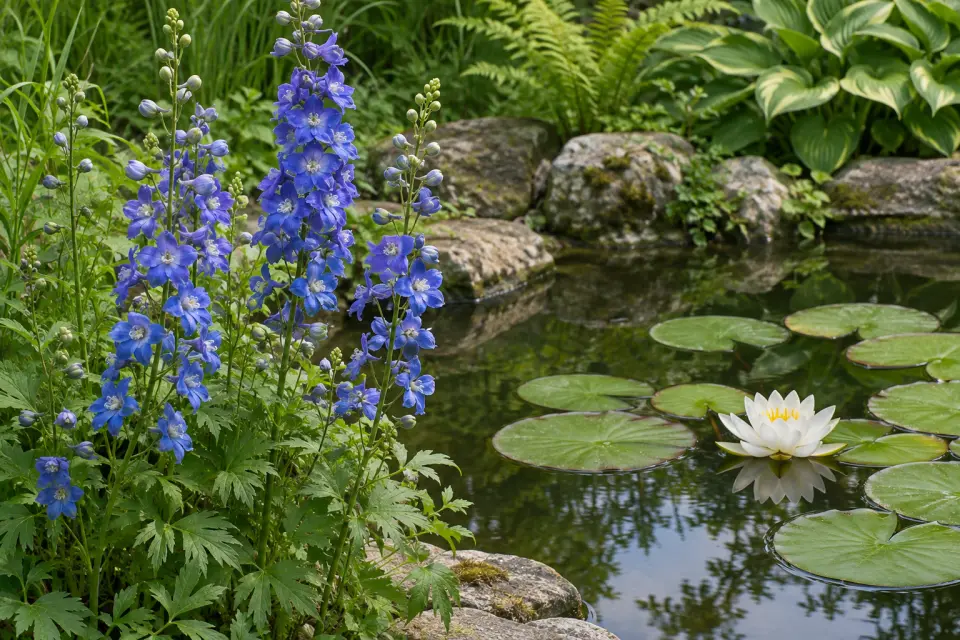
In many English lists, the July birth flowers are the larkspur and the water lily. July is high summer in the Northern Hemisphere, and both plants are at their best then in many gardens and ponds. A birth flower is a symbol tied to a month. It is not a portrait of people born in July.
Controlled tests of birth-date or birth-chart personality prediction did not find an effect (Carlson, 1985; Hartmann et al., 2006). Those studies are about Western astrology and birth date. They are not a trial of these flowers.
Larkspur (Consolida)
The plant
The garden larkspur is an annual, usually Consolida ajacis, and botanists once placed it in the genus Delphinium. Older books call it Delphinium consolida or Delphinium ajacis. It can grow to about a meter, with flowers stacked up the stem in blue, purple, pink, and white.
The English name is usually explained by the long spur at the back of each flower, likened to the long hind claw of a lark.
Dolphin in the name
The genus name Delphinium comes from the Greek word for dolphin. The usual explanation is that the unopened bud looks like a dolphin. That is where the link to the Greeks ends: it is a name, not a myth about the flower.
Meanings on the lists
In Kate Greenaway’s Language of Flowers (1884), larkspur stands for lightness and levity. The same book gives pink larkspur as fickleness and purple larkspur as haughtiness. Modern gift lists add warmer meanings, such as a strong bond of love, an open heart, or the ardor of first love. Those are recent glosses, not the old definitions.
Some websites also pair larkspur colors with chakras. That pairing is a modern association with no source in the flower-language tradition, and this page does not use it.
Safety: larkspurs, like their delphinium relatives, contain toxic alkaloids, and the seeds and young plants are the most dangerous parts. Wild larkspurs are a well-known poison of cattle on North American rangelands. Do not eat any part of the plant, and keep it away from children and pets. If some has been swallowed, call a poison center or a doctor.
Water lily (Nymphaea)
The plant
Water lilies are aquatic plants of the genus Nymphaea. They root in the mud at the bottom of still water, and their round leaves and flowers float on the surface or rise just above it. The flowers of many kinds open in the day and close in the evening.
The water lily is not the sacred lotus
The two plants are often mixed up. The sacred lotus of India and East Asia is Nelumbo nucifera. It looks similar, but it is not a close relative of the water lily: botanists place the two in different orders. Its leaves and flowers stand well above the water on tall stalks.
The confusion is old. The so-called lotus of ancient Egypt was actually a water lily, the blue Nymphaea caerulea and the white Nymphaea lotus. In one Egyptian account of creation, the young sun rose from a lotus flower on the waters at the beginning of the world, and the god Nefertem was tied to the blue lotus. The lotus is also a hieroglyph, and lotus shapes were used for the tops of temple columns.
The lotus in Buddhist and Hindu images
The picture of a flower rising clean out of muddy water belongs mainly to the sacred lotus. In the Pali canon, the Buddha compares himself to a lotus that grows in the water and stands above it unstained (Doṇa Sutta, AN 4.36). In Hindu art, the goddess Lakshmi sits or stands on a lotus. The saying that there is no lotus without mud is a modern teaching, best known from the Vietnamese Zen teacher Thich Nhat Hanh. Because the two flowers look alike, many people carry these lotus meanings over to the water lily.
Meanings on the lists
Kate Greenaway’s 1884 list gives the water lily as purity of heart. Korean and Japanese flower-language lists commonly give a close meaning, a pure heart (청순한 마음, 清純な心). Enlightenment, rebirth, and peace are later glosses, mostly borrowed from the lotus.
Across traditions
| Tradition | Plant meant | Image |
|---|---|---|
| Ancient Egypt | Water lily (N. caerulea, N. lotus), called lotus | Creation, the rising sun |
| Buddhist | Sacred lotus (Nelumbo) | Purity rising from mud, awakening |
| Hindu | Sacred lotus (Nelumbo) | Lakshmi, purity, beauty |
| Victorian English | Water lily | Purity of heart |
| Korean and Japanese lists | Water lily (수련, スイレン) | A pure heart |
What the month symbol does not do
On these lists, the larkspur and the water lily stand for the month of July. They do not say who a July-born person is, and they do not promise lightness, purity, or awakening. The plants are traditional pictures for a summer month, each with its own history, and that history is worth keeping apart from the meanings later lists have added.
References
- Carlson, S. (1985). A double-blind test of astrology. Nature, 318, 419–425.
- Hartmann, P., Reuter, M., & Nyborg, H. (2006). The relationship between date of birth and individual differences in personality and general intelligence: A large-scale study. Personality and Individual Differences, 40(7), 1349–1362.
- Greenaway, Kate. Language of Flowers (1884).
- Doṇa Sutta, Aṅguttara Nikāya 4.36.
- Thich Nhat Hanh. No Mud, No Lotus (2014).