August Birth Flowers: Gladiolus and Poppy
Explore gladiolus and poppy as an August birth-flower convention. Distinguish botanical names, remembrance history, and symbolic gift messages without predicting personality or health.
Last reviewed 2026-10-08
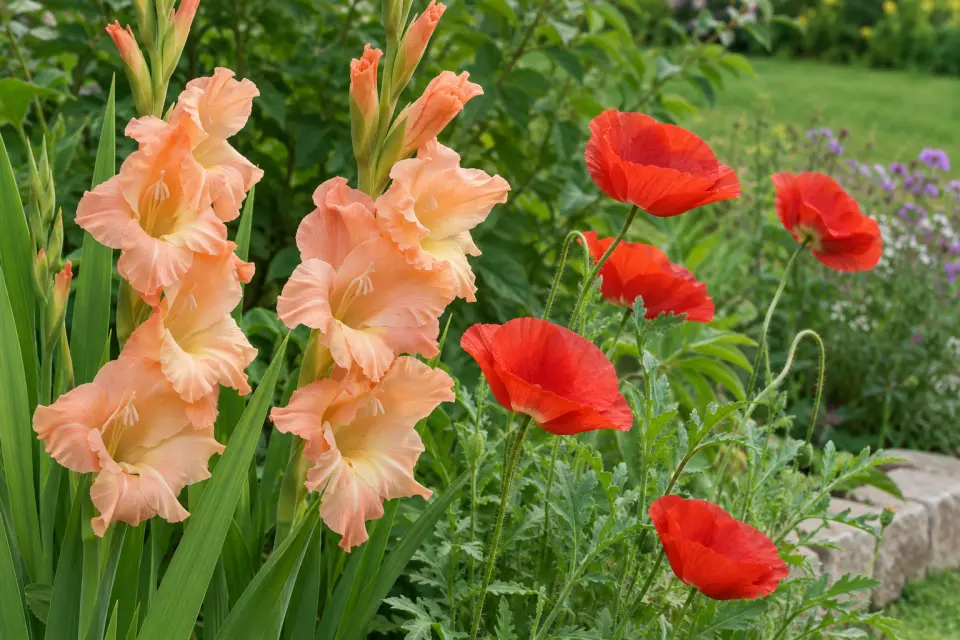
An August convention, not a universal calendar
This guide uses the gladiolus-and-poppy August birth-flower convention. It is not an official botanical calendar for every country. August is not summer everywhere, and choosing a birth flower does not establish a person’s character, health, or destiny.
Three kinds of information are useful here: what a plant’s name refers to, how a flower has appeared in a particular cultural tradition, and what you choose to say through a gift. Keeping them separate lets you enjoy the symbolism without turning it into a prediction.
Gladiolus: a name shaped by the leaves
RHS connects the name Gladiolus with the Latin word for sword and the plant’s sword-shaped leaves. The name describes the plant’s appearance; the story of Roman spectators throwing these flowers to victorious gladiators has not been established by the sources used here.
You can also look at the flower’s structure before interpreting it. RHS describes upright flower spikes with funnel-shaped flowers that open outward, beginning near the base. Gladiolus grows from a corm. These details explain the plant’s distinctive appearance without attaching a personality to it.
The RHS school resource gives strength of character as a symbolic meaning of gladiolus. Treat this as an example of flower symbolism, not a measured quality of people born in August. A recipient can appreciate the shape or colour without sharing that meaning.
Flower-language books do not always agree. This guide therefore does not assign a fixed meaning to every gladiolus colour or claim that the flower has one meaning across Europe. Choose a colour the recipient likes rather than assuming it carries a universal coded message.
Poppy: distinguish two species
The common word poppy is not enough to identify a species. Kew’s account of two poppies distinguishes the field or corn poppy, Papaver rhoeas, from the opium poppy, Papaver somniferum.
| Name | What this guide discusses | What not to infer |
|---|---|---|
| Gladiolus | Sword-shaped leaves and an example of flower symbolism | An August birthday proves strength or integrity |
| Papaver rhoeas | The red field poppy associated with remembrance | Every ornamental poppy has the same cultural meaning |
| Papaver somniferum | A separate species with an opium-related history | A flower gift is a treatment or offers a predictable health effect |
The distinction matters because a history involving one species does not make every poppy a medicine. This article does not provide medical advice, effects, or instructions for using plants as a treatment.
The remembrance poppy has a particular history
According to the Royal British Legion, poppies grew in disturbed battlefield soil during the First World War. They were not only flowers that appeared after the war had ended.
John McCrae wrote In Flanders Fields in 1915. The poem helped connect the red poppy with remembrance, but the later custom also involved people campaigning to use the flower as a symbol, including Moina Michael and Anna Guérin. The British Legion adopted the poppy in 1921.
This is a particular remembrance tradition, not a rule for every country or every poppy. In the British context, wearing a remembrance poppy is a personal choice. The symbolism may suit a commemorative occasion but may not be what someone wants for a birthday.
Symbolism is not a personality assessment
A flower can have meaning in a poem, memorial, or gift without proving something about the recipient. Botanical names, cultural history, and editorial interpretation are different kinds of claims.
For example, a red poppy may recall a public remembrance ceremony for one person, while another thinks of a field of flowers. A gladiolus may be chosen for its sword-shaped leaves or for a personal message about effort. Neither interpretation has to describe everyone with an August birthday.
If a symbolic meaning matters to the person receiving the flower, ask about that context. Their interpretation may differ from a flower-language book, and neither has to become a diagnosis or prediction.
Choose a message for the actual occasion
These are editorial gift-writing examples, not traditional meanings confirmed by a source. Adapt them to the recipient rather than applying them to everyone born in August.
| Occasion | A possible message | A useful boundary |
|---|---|---|
| Birthday | I chose this colour because you enjoy it. | A birth month does not determine personality |
| Recognising an effort | I wanted to acknowledge what you put into this. | The message comes from your knowledge of the person, not the plant |
| Remembrance | I am thinking of the person or event you want to remember. | Ask whether this symbol fits; do not promise relief from grief |
For a birthday, the flower’s appearance or the recipient’s preferences may be enough. For remembrance, consider the community and occasion. You do not need to make a universal spiritual claim for a gift to feel personal.