December Birth Flowers: Holly, Narcissus, and Poinsettia
English lists give December holly and the paperwhite narcissus, and some add the poinsettia. This page separates the plants, the folklore, and the legend, notes what is and is not toxic, and does not read people born in December.
Last reviewed 2026-04-01
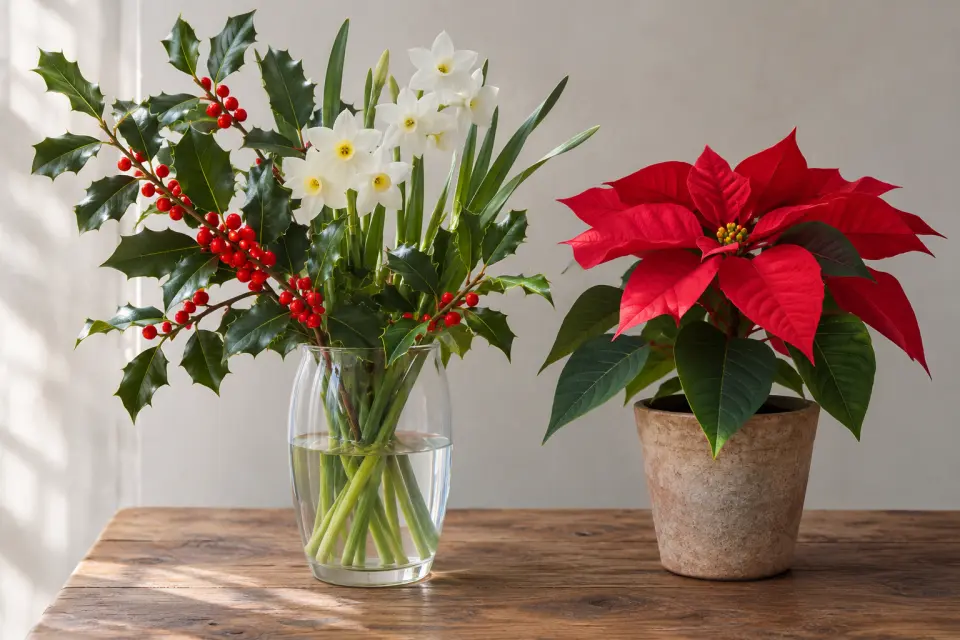
In many English lists, the December birth flowers are holly and the narcissus, usually the paperwhite. Some newer lists add the poinsettia, the plant most people now link with Christmas. A birth flower is a symbol tied to a month. It is not a portrait of people born in December.
Hartmann et al. (2006) did not find that birth date predicts personality. Controlled tests of birth-date or birth-chart personality prediction did not find an effect (Carlson, 1985; Hartmann et al., 2006). Those studies are about Western astrology and birth date. They are not a trial of these flowers.
Holly (Ilex aquifolium)
The plant
Ilex aquifolium is the European holly. It keeps its glossy, spiny leaves through winter. Holly plants are male or female, and only female plants bear the red berries, so a holly with no berries is not always a sick one. In North America, the American holly (Ilex opaca) fills much the same seasonal role.
Winter green in old texts and songs
Evergreens were brought indoors at midwinter in many parts of Europe, and holly was one of them. Pliny the Elder, in Natural History book 24, records a belief that holly planted by a house keeps off harmful magic. Later British folklore also said holly guarded against lightning and ill luck. These are beliefs that were written down, not tested effects.
The traditional English carol The Holly and the Ivy reads the plant in Christian terms: a berry as red as blood and a prickle as sharp as a thorn. In the 14th-century poem Sir Gawain and the Green Knight, the Green Knight arrives at the Christmas feast holding a branch of holly.
The Holly King and the Oak King
Many websites call the Holly King and the Oak King, who trade rule of the year at the solstices, an ancient Celtic tradition. That pairing is mostly a 20th-century idea, shaped by Robert Graves’s The White Goddess (1948) and later modern pagan practice. It is a living modern tradition, but it is not a recorded custom of the ancient Celts or the druids.
Meanings on the lists
In 19th-century English language-of-flowers books, such as Kate Greenaway’s (1884), holly stands for foresight. Protection, hope in hard times, and a warm home are later popular glosses that draw on the folklore above.
Safety: holly berries are not food. Eating them can cause vomiting and diarrhea, and they are a common worry with small children and pets. If someone has swallowed several, call a poison center or a doctor.
Narcissus, the paperwhite (Narcissus papyraceus)
The plant
The paperwhite is a Mediterranean narcissus with clusters of small white, strongly scented flowers. Its bulbs are easy to force indoors in water or pebbles, which is why it blooms on so many December windowsills.
The New Year narcissus is a relative
The narcissus grown for Lunar New Year in China and elsewhere in East Asia is usually Narcissus tazetta var. chinensis. It is a close relative of the paperwhite, in the same tazetta group, but it is not the same plant. Growers time the bulbs to open near the new year, and the flower is a common sign of good fortune for the season. That custom belongs to the tazetta narcissus, so it is not a December birth-flower meaning in itself.
Meanings on the lists
In Kate Greenaway’s 1884 list, narcissus is given as egotism, an echo of the myth in Ovid’s Metamorphoses, book 3. Modern gift lists often turn this into self-respect, pure love, or good luck. Those softer readings are recent glosses, not old definitions. The March birth flower page sorts out the myth and the other plants called narcissus.
Safety: every part of a narcissus is toxic if eaten, and the bulbs are the worst part. Bulbs have been mistaken for onions in kitchens. Keep them away from food, children, cats, and dogs. If a bulb has been eaten, call a poison center or a doctor.
Poinsettia (Euphorbia pulcherrima)
The plant
The poinsettia is native to Mexico and Central America, where it grows as a shrub or small tree. The red parts are bracts, which are modified leaves. The true flowers are the small yellow-green structures at the center.
Names and history
In Nahuatl, the language of the Aztecs, the plant is cuetlaxochitl. The meaning of that name is explained in different ways, so this page does not fix one translation. Sources on Aztec use report that the bracts gave a red dye and that the plant had medicinal uses. Those are historical reports, not medical advice.
In Mexico the plant is called flor de Nochebuena, the Christmas Eve flower. Franciscan friars near Taxco are often said to have used it in 17th-century nativity processions. The English name comes from Joel Roberts Poinsett, the first US minister to Mexico, who sent plants home in the late 1820s. In the United States, 12 December, the date of his death in 1851, is marked as Poinsettia Day.
The legend of the humble gift
A Mexican Christmas legend tells of a poor girl, often called Pepita, with nothing to bring to the nativity on Christmas Eve. She gathers weeds from the roadside, and when she lays them before the altar they turn into red flowers. Names and details change between tellings. The story is a legend about a gift given with love, not a historical event.
Meanings on the lists
The poinsettia does not appear in the older Victorian flower lists. Good cheer, success, and the idea that no loving gift is too small are modern Christmas meanings, the last one drawn from the legend.
Safety, and an overstated warning: the poinsettia is often called deadly, and it is not. A 1996 study of more than 22,000 poinsettia exposures reported to US poison centers found no deaths, and most people had no symptoms (Krenzelok et al., 1996). The milky sap can still irritate skin and eyes, people with a latex allergy may react to it, and eating the leaves can upset the stomach. For cats and dogs, the ASPCA lists it as mildly toxic, with mouth and stomach irritation. It is a plant to keep out of reach, not a reason for panic.
What the month symbol does not do
On these lists, holly, narcissus, and poinsettia stand for the month of December. They do not say who a December-born person is, and they do not promise protection, luck, or a turn in someone’s fortunes. The plants are traditional pictures for a winter month, each with its own history, and that history is worth keeping apart from the meanings later lists have added.
References
- Carlson, S. (1985). A double-blind test of astrology. Nature, 318, 419–425.
- Hartmann, P., Reuter, M., & Nyborg, H. (2006). The relationship between date of birth and individual differences in personality and general intelligence: A large-scale study. Personality and Individual Differences, 40(7), 1349–1362.
- Krenzelok, E. P., Jacobsen, T. D., & Aronis, J. M. (1996). Poinsettia exposures have good outcomes… just as we thought. American Journal of Emergency Medicine, 14(7), 671–674.
- Pliny the Elder, Natural History, book 24 (holly).
- Ovid, Metamorphoses, book 3 (Narcissus).
- Greenaway, Kate. Language of Flowers (1884).
- Graves, Robert. The White Goddess (1948).
- ASPCA Animal Poison Control: toxic and non-toxic plants