Crystal healing guide: stones often named, and the customs around them
Colors and symbols often attached to stones in crystal healing, the customs called cleansing, and the controlled experiment of French and others. The piezoelectric effect is a story about quartz in clocks. It is not evidence that the body is healed.
Last reviewed 2026-06-02
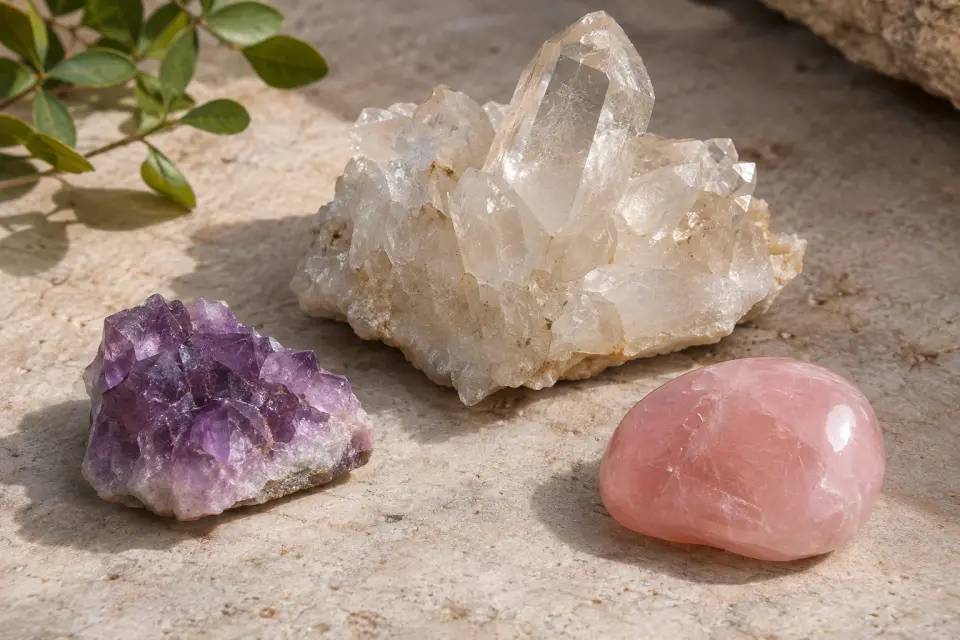
Attaching a meaning to stones is a custom in more than one culture. In ancient Egypt, lapis lazuli was used as ornament and as a stone of protection. In East Asia, jade has long been held dear. The name crystal healing today is not that whole older custom. It is closer to a modern practice in which the wellness market writes an effect next to each stone and sells it.
The physics of a stone, and the word healing
A crystal is a mineral that grew for a long time until it became a crystal. Quartz has a piezoelectric effect: when it is pressed, a weak voltage appears. Clocks, and the oscillators in electronic circuits, actually use that. The fact is not evidence that holding a stone heals a person’s body.
People who practice crystal healing say that each stone resonates with a chakra or with energy. A chakra is a symbol of a state of mind. It is not a map for treating the organs.
The experiment. In a controlled experiment, people holding a real crystal and people holding a fake one reported similar sensations. The difference sits closer to expectation than to the stone (French et al., 2001). Using a stone as an anchor for meditation can remain apart from that result. It is not treatment of an illness.
Symbols that often get attached
The last column is wording that shops and modern tradition commonly attach. It is not an effect. The same stone sometimes appears under two topics. Green aventurine does.
Love and relationships
| Stone | Color | Words often attached |
|---|---|---|
| Rose quartz | Pink | Self-acceptance, tenderness |
| Rhodonite | Pink and black | Forgiveness, a knot in a relationship |
| Moonstone | White, iridescent | Beginnings, a symbol of intuition |
| Amethyst | Purple | Moderation, a stone for meditation |
Wealth and prosperity
| Stone | Color | Words often attached |
|---|---|---|
| Citrine | Yellow, orange | A symbol of abundance |
| Pyrite | Brass-colored | A symbol of money and of confidence |
| Green aventurine | Green | A symbol of opportunity and of growth |
| Tiger’s eye | Golden brown | Resolve, and a custom of putting it in a wallet |
Money and luck are symbols. Setting a stone down does not raise income.
Protection and cleansing
| Stone | Color | Words often attached |
|---|---|---|
| Black tourmaline | Black | Grounding, a stone that brings a boundary to mind |
| Obsidian | Black | Protection, seeing a thing as it is |
| Selenite | White | A symbol of putting a space in order |
| Labradorite | Gray, iridescent | Change, a symbol of intuition |
Talk of a film that blocks negative energy is market talk.
Focus and speech
| Stone | Color | Words often attached |
|---|---|---|
| Clear quartz | Clear | An anchor for writing an intention down |
| Fluorite | Purple, green | A custom of keeping it where you study |
| Sodalite | Blue, white | A symbol of speech and of logic |
| Lapis lazuli | Blue, with gold flecks | An old symbol of wisdom and of expression |
This page does not follow the claim that clear quartz amplifies every intention, or that it heals as a cure-all.
Symbols of feeling and of recovery
| Stone | Color | Words often attached |
|---|---|---|
| Green aventurine | Green | A symbol of the heart chakra. Not a treatment for heart disease |
| Aquamarine | Sky blue | A color that brings courage to mind |
| Malachite | Green, black | A symbol of change and of feeling |
| Amber | Gold, orange | Warmth, a symbol of something old |
If the body is ill, it is better to see a clinician than to turn to a stone.
Customs called cleansing
There is no rule that a stone must be cleansed before you use it. The claim that it absorbs a previous owner’s energy is not an experimental fact. What follows are rituals people perform.
- Moonlight. On the night of a full moon, leave it by the window and bring it in in the morning. For most stones this is physically gentle.
- Sunlight. Some people leave a stone in the morning sun for a short while. A colored stone such as amethyst can fade if it stays out for a long time.
- Water. Some people rinse a stone briefly. Selenite is gypsum, so water damages it, and malachite is also easily damaged by water and by acid. Do not put those two in water.
- Smoke. People wrap the stone in the smoke of white sage or palo santo. You do not have to recite a spell for them to call it a cleansing.
- A cluster of clear quartz. A custom of leaving other stones on it for a day. There is no evidence that energy moves across.
Writing an intention
There is an order in which, after cleansing, a purpose is set into the stone. You hold it, steady the breath, bring to mind what you want to do, and say that this stone is activated for that purpose. Activation is not a physical switch. It is a ritual of saying aloud what you mean to do. It does not mean that picturing only the result, as if it had already happened, raises achievement.
Where people put them
Placements people often write down.
- Rose quartz or amethyst in the bedroom. This is not a treatment for sleep. If sleep stays poor for a long time, see a clinician.
- Citrine or clear quartz where you work.
- Black tourmaline or obsidian by the entrance.
The claim that a necklace against the skin passes energy more strongly is sales copy. So is the claim that citrine in a wallet brings luck with money.
Three stones often named first: clear quartz, rose quartz, and black tourmaline. That does not mean they handle most situations. They are only names that come up often at the start.
Related reading: Chakras · Tarot for beginners · Numerology
References
The history and legends of gemstones follow the sources below. Talk of chakras, healing, and energy is a symbol passed along.
- Kunz, G. F. (1913). The Curious Lore of Precious Stones. J. B. Lippincott.
- Gemological Institute of America. Birthstones. https://www.gia.edu/birthstones
- French, C. C., Williams, L., & O’Donnell, H. (2001). Crystal healing: A test of the placebo effect. British Psychological Society Centenary Annual Conference, Glasgow.