March Birth Flowers: Daffodil and Jonquil
English lists usually give March the daffodil, genus Narcissus, and often name the jonquil beside it. This page separates species, myth, and folk sayings, and it does not read people born in March.
Last reviewed 2026-04-01
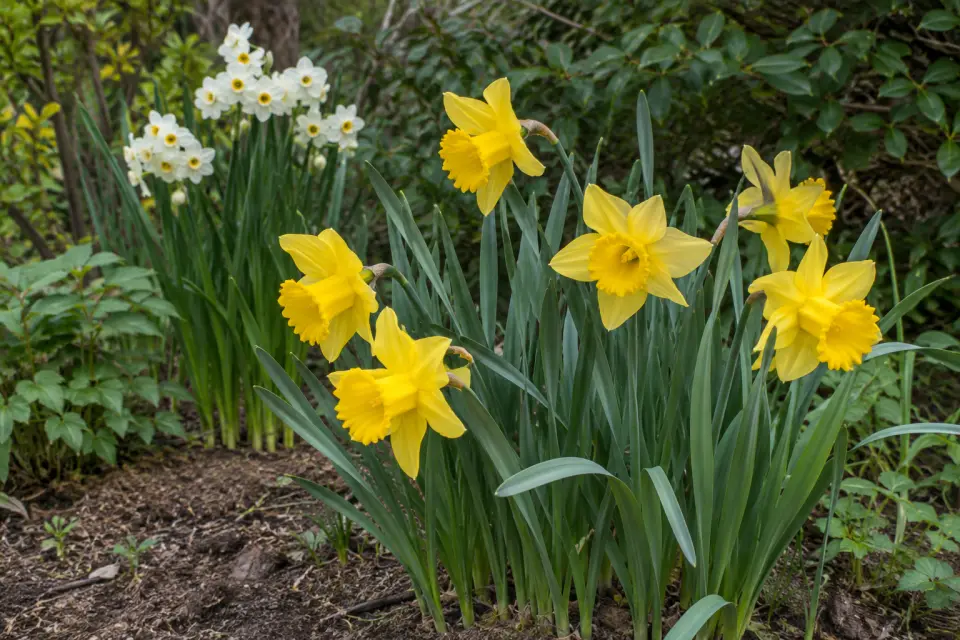
In many English lists, the March birth flower is the daffodil, in the genus Narcissus. Jonquil is often written next to it. A birth flower is a symbol tied to a month. It is not a portrait of people born in March.
Hartmann et al. (2006) did not find that birth date predicts personality. Controlled tests of birth-date or birth-chart personality prediction did not find an effect (Carlson, 1985; Hartmann et al., 2006). Those studies are about Western astrology and birth date. They are not a trial of this flower.
The daffodil, and which plant that name covers
Narcissus pseudonarcissus is the wild daffodil. Garden daffodils are often hybrids, so a stem sold as a daffodil is not always that wild species.
A myth, not a lesson
Ovid’s Metamorphoses, book 3, tells of Narcissus wasting away over his reflection. Tellings differ about how the flower begins. It is a myth. It is not a finding that the death of the ego makes a person beautiful, and it is not a reading of character.
A poem about the flowers
William Wordsworth’s poem I Wandered Lonely as a Cloud, in Poems in Two Volumes (1807), is about daffodils. The poem is a literary response. It does not fix a meaning for the month, and it does not describe a person.
Wales, the daffodil, and the leek
In Wales, a daffodil (Cennin Pedr) is worn on St David’s Day, 1 March. The leek is the older emblem. This page does not treat the daffodil as the single official national flower, as if the leek were not there.
A saying about one stem, or three
A repeated English folk saying holds that a single daffodil given as a gift is unlucky, and that the flowers are given in bunches, often of three. It is a saying, not a rule.
Gold is sometimes used only as a color metaphor for the solar-plexus image, not as anatomy, a symptom, or a frequency.
Jonquil, a different species
Jonquil is Narcissus jonquilla. It often carries several flowers on one stem, with rush-like leaves and a strong scent. It shares the genus Narcissus with the daffodil. It is not the same species as the wild daffodil, Narcissus pseudonarcissus.
In a 19th-century popular language of flowers, jonquil was given the line I desire a return of affection. That line belongs to a list from that period. It is not a classical definition of the plant, and it is not a promise about love.
The same common name is not always the same plant
The narcissus of Lunar New Year is usually Narcissus tazetta var. chinensis. It is a relative. It is not the same plant as the wild European daffodil.
Persian poetry often uses narges, and Japanese poetry often uses suisen (スイセン). Those images are frequently a tazetta narcissus as well. Putting them in one species with Narcissus pseudonarcissus would blur the plants.
Self-love is a gloss often repeated in modern lists for the narcissus. This page did not check that gloss in a classical flower dictionary, and it does not add respect as a sourced meaning.
What the month symbol does not do
On these lists, the daffodil and the jonquil stand for the month of March. They do not announce who a March-born person is. They do not say that anyone is the start of a season. The flower is a traditional picture for a month, not a result about a person.
References
- Ovid, Metamorphoses, book 3 (Narcissus).
- Wordsworth, William. Poems in Two Volumes (1807), including I Wandered Lonely as a Cloud.