June Birth Flowers: Rose, Honeysuckle and Gift Ideas
Explore sourced rose colour meanings, honeysuckle’s botanical differences and thoughtful gift ideas, without treating birth flowers as personality or health predictions.
Last reviewed 2026-10-07
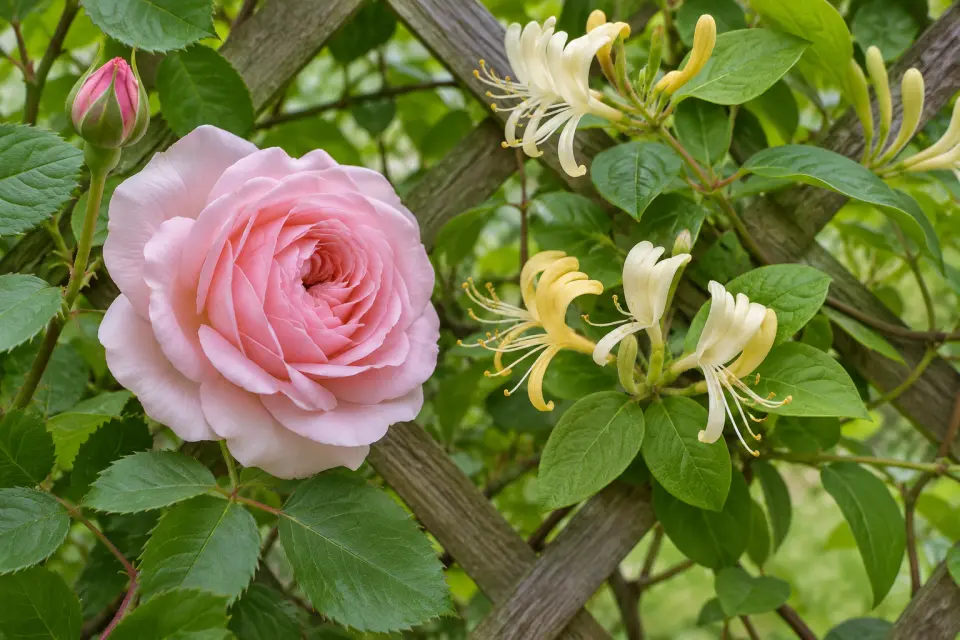
A cultural convention, not a personality test
The Old Farmer’s Almanac lists rose and honeysuckle as June birth flowers. This is that publication’s convention, not a globally certified calendar. Other lists may differ. Birth month does not determine personality, relationships or fortune.
June is not the beginning of summer everywhere, and these plants need not bloom then in every region. Use the flowers to introduce a message, not to infer boldness or loyalty. Someone born in June is free to dislike them.
Rose colours: explain your intended message
The Almanac links roses with love, beauty and affection. Its colour meanings are one vocabulary, not a code everyone knows. Yellow in particular has more than one association.
| Colour | Association in this source | Editorial message example |
|---|---|---|
| Red | Romantic love | “I’m happy to share this day with you.” |
| Pink | Happiness and admiration | “There is so much I appreciate about you.” |
| White | Innocence and purity | “Wishing you a good start to this next chapter.” |
| Orange | Desire and excitement | “I’m excited for what you’re looking forward to.” |
| Yellow | Cheer and happiness; jealousy in some folklore | “Thank you for the bright moments we’ve shared.” |
The final column is written by the editors, not quoted from a flower dictionary. White does not prove a person is pure; red does not oblige a romantic response. Explain your intention if it could be misunderstood. We do not offer an unverified numerical code assigning a guaranteed message to a rose count.
Check the actual rose, not just its colour
RHS’s rose guide uses the botanical name Rosa and describes shrubs, climbers and miniature forms. Size, fragrance and flowering periods vary. Symbolic colour alone cannot tell you whether a living plant suits a home or garden.
For a bouquet, ask about the actual flowers, scent and handling. For a living plant, confirm mature size, support and local growing conditions with the supplier. RHS gives UK horticultural guidance, not a worldwide seasonal timetable. A picture can convey the symbol when a live plant is inconvenient.
Honeysuckle is not always a vine
The Almanac associates honeysuckle with happiness, affection for new love and nostalgia. It can introduce a shared memory, without suggesting that affection requires becoming inseparable or ignoring boundaries.
Lonicera includes shrubs as well as twining climbers. RHS’s Lonicera sempervirens profile gives a climbing example. Its Lonicera fragrantissima profile describes a bushy shrub flowering in winter and early spring in that horticultural context. Neither one growth habit nor June flowering applies to all honeysuckles.
Both profiles warn against eating the berries of those named species. Do not use a gift article as advice to taste ornamental berries or nectar. These warnings also do not establish identical toxicity for every Lonicera. Confirm the actual plant rather than relying on a translated common name. We do not attribute calming medicinal effects, protection from nightmares or chakra effects to the flower.
Start with the recipient
These are editorial choices, not June requirements. You need not buy both flowers or spend more to reach a supposed lucky number.
| Situation | What to check | Possible choice |
|---|---|---|
| Birthday card | Do they enjoy floral imagery? | A drawing and a specific shared memory |
| Bouquet | Do they like the colour and scent? | Explain the message in your own words |
| Living plant | Is there space and willingness to care for it? | Confirm species and growing needs first |
| Flowers are unwelcome | What would they prefer? | A non-floral gift with the same kind wish |
For a new beginning: “I’m cheering you on for the next step.” For a memory: “This flower reminded me of the time we spent together.” These are optional editorial examples, not traditional quotations. Use a photograph or illustration you own or have permission to use, and check that it shows the intended plant.
Questions and evidence boundaries
Do June-born people share these flowers’ traits? The convention does not establish that. A chosen symbol is not a personality assessment.
Does everyone understand colours or flower counts alike? No. Say what you mean; preferences and context matter more than an assumed code.
Does historical or spiritual symbolism prove health benefits? No. This article does not recommend flower preparations or claim therapeutic effects.
The Almanac supports its birth-flower and colour associations. RHS supports botanical differences and warnings for the two named species. Gift examples are editorial suggestions. The old article’s sweeping ancient-history anecdotes, fixed rose-count meanings and regional magical claims were not verified in this review and are not repeated as established facts.