November Birth Flowers: Chrysanthemum and Peony
Most English lists give November the chrysanthemum, and some add the peony. This page looks at the plants, their history in Japan and China, the myth behind the peony's name and what is and is not toxic, and does not read people born in November.
Last reviewed 2026-04-01
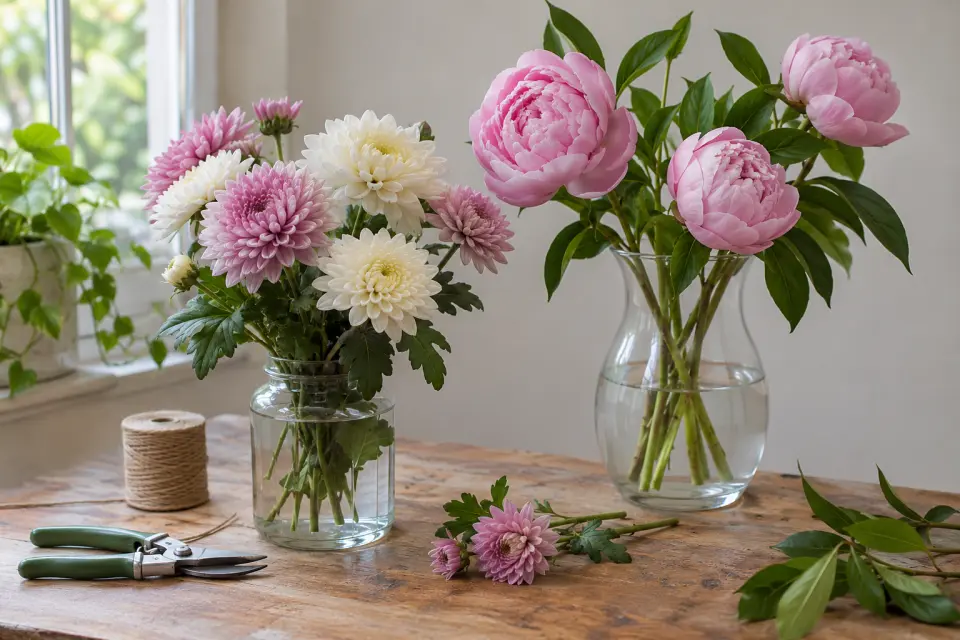
November sits between the last autumn color and the start of winter. Most English lists give it the chrysanthemum, a flower with a long history in East Asia, and some lists add the peony, which Chinese tradition calls the king of flowers. A birth flower is a symbol tied to a month. It is not a portrait of people born in November.
Hartmann et al. (2006) did not find that birth date predicts personality. Controlled tests of birth-date or birth-chart personality prediction did not find an effect (Carlson, 1985; Hartmann et al., 2006). Those studies are about Western astrology and birth date. They are not a trial of these flowers.
Chrysanthemum (Chrysanthemum × morifolium)
The plant
The garden chrysanthemum is a hybrid that was developed in China and later bred in great variety in Japan. It is a short-day plant: it starts to flower when the nights grow long, which is why it opens in autumn, after most garden flowers have finished. Growers now control the light to sell potted chrysanthemums all year.
In China
Chrysanthemums appear in some of the oldest Chinese texts. The “Monthly Ordinances” chapter of the Book of Rites (Liji) notes that in the last month of autumn the chrysanthemum has yellow flowers. The Eastern Jin poet Tao Yuanming is closely tied to the flower. A line from the fifth of his Drinking Wine poems, about picking chrysanthemums by the eastern fence and seeing the southern mountain, is among the best-known lines in Chinese poetry.
With the plum, the orchid and bamboo, the chrysanthemum is one of the Four Gentlemen of Chinese, Korean and Japanese painting. Because it flowers in the cold, it came to stand for integrity that holds up when conditions turn hard. On the Double Ninth Festival, the ninth day of the ninth lunar month, people in China traditionally drank chrysanthemum wine and wished for long life.
In Japan
Japan took over the Double Ninth as the Chrysanthemum Festival (Chōyō no sekku), and the flower became tied to long life. Tradition credits Emperor Go-Toba, around the turn of the 13th century, with using the chrysanthemum as a personal crest. In the early Meiji period, from 1868, the government reserved the sixteen-petal chrysanthemum crest for the imperial family, and it remains the imperial emblem. In English the Japanese monarchy is often called the Chrysanthemum Throne, and a simplified chrysanthemum appears on the cover of Japanese passports.
Meanings on the lists
| Tradition | Meaning |
|---|---|
| Japan | Long life, linked to the Chrysanthemum Festival; also the imperial emblem |
| China | Integrity and noble character (one of the Four Gentlemen) |
| Korea | Integrity and loyalty in painting and poetry; today white chrysanthemums are also the usual funeral flower |
| Victorian England | In Kate Greenaway’s list (1884), red means “I love”, white means truth, and yellow means slighted love |
| France, Italy, Belgium | Laid on graves for All Saints’ Day, so they read as a funeral flower; check before giving them as a gift |
Gift sites today often add friendship, joy and optimism. Those are modern glosses, not old definitions.
Safety: chrysanthemums are not for pets. The ASPCA lists them as toxic to cats and dogs, with vomiting, diarrhea and drooling. Some people who handle them often get an itchy skin rash. If a pet has eaten some, or a rash does not settle, call a vet or see a doctor.
Peony (Paeonia)
The plant
Peonies come in two main forms. Herbaceous peonies such as Paeonia lactiflora die back each winter, and tree peonies such as Paeonia suffruticosa keep a woody frame. Both flower in late spring or early summer, so a November peony is a cut flower grown somewhere else or under glass, not one from a local garden.
The king of flowers
In Chinese the tree peony, mudan, has long been called huawang, the king of flowers. Under the Tang dynasty, peonies became a fashion in the capital, Chang’an, and Bai Juyi’s poem Buying Flowers says that one clump of deep-colored peonies cost as much as the taxes of ten ordinary households. The flower became a symbol of wealth and high rank, and it still appears on paintings, porcelain and embroidery. In Korea, folding screens painted with peonies were used at weddings.
The name and the myth
In Homer’s Iliad, book 5, Paeon, the healer of the gods, treats a wound that Heracles gave to Hades. Pliny the Elder, in Natural History book 25, says the peony keeps the name of Paeon. The story that Paeon himself was turned into the flower to save him from a jealous rival is a later retelling, not part of Homer. It is a myth about the name, not evidence that the plant heals.
Meanings on the lists
- Wealth and honor: the main Chinese meaning, from the Tang fashion above
- Marriage: a common wedding motif in China and Korea
- Bashfulness: in Kate Greenaway’s list (1884) the peony stands for shame or bashfulness
- Romance: a modern gift-list meaning, drawn from the full, showy flower
Safety: peony roots and bark have a long place in traditional Chinese medicine, but that is history, not medical advice. The ASPCA lists peonies as toxic to cats, dogs and horses, with vomiting and diarrhea, and the bark holds the most. Keep the plant out of reach of pets, and call a vet if one has eaten some.
What the month symbol does not do
On these lists, the chrysanthemum and the peony stand for the month of November. They do not say who a November-born person is, and they do not promise long life, wealth, a good marriage or a turn in someone’s fortunes. They are old pictures with their own histories in China, Japan, Korea and Europe, and those histories are worth keeping apart from the meanings later lists have added. The series continues with the December birth flowers.
References
- Carlson, S. (1985). A double-blind test of astrology. Nature, 318, 419–425.
- Hartmann, P., Reuter, M., & Nyborg, H. (2006). The relationship between date of birth and individual differences in personality and general intelligence: A large-scale study. Personality and Individual Differences, 40(7), 1349–1362.
- Book of Rites (Liji), “Monthly Ordinances” (Yueling), last month of autumn.
- Tao Yuanming, Drinking Wine (Yinjiu), poem 5.
- Bai Juyi, Buying Flowers (Maihua).
- Homer, Iliad, book 5 (Paeon heals Hades).
- Pliny the Elder, Natural History, book 25 (peony).
- Greenaway, Kate. Language of Flowers (1884).
- ASPCA Animal Poison Control: toxic and non-toxic plants