October Birth Flowers: Marigold and Cosmos
English lists give October the marigold and the cosmos. This page separates the two plants called marigold, the Day of the Dead custom, the old flower-book meanings, and the story behind the name cosmos, and does not read people born in October.
Last reviewed 2026-04-01
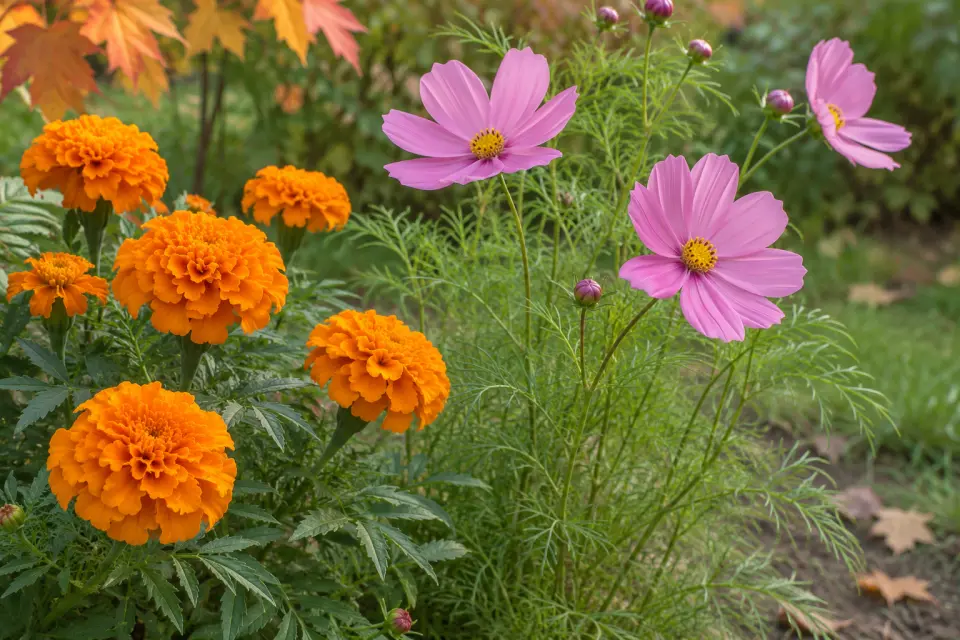
In many English lists, the October birth flowers are the marigold and the cosmos. Both bloom into autumn: the marigold in strong orange and gold, the cosmos in light pink, white, and crimson on thin stems. A birth flower is a symbol tied to a month. It is not a portrait of people born in October.
Hartmann et al. (2006) did not find that birth date predicts personality. Controlled tests of birth-date or birth-chart personality prediction did not find an effect (Carlson, 1985; Hartmann et al., 2006). Those studies are about Western astrology and birth date. They are not a trial of these flowers.
Marigold (Tagetes and Calendula)
Two plants, one name
The English word marigold covers two different plants. Both are in the daisy family (Asteraceae), but they belong to different genera.
Tagetes is the marigold of the Americas, native to Mexico and Central America. Tagetes erecta, with its large orange and yellow heads, is the flower of the Day of the Dead. In garden catalogs it is often sold as the African marigold, a name that hides its Mexican origin.
Calendula (Calendula officinalis), the pot marigold, comes from southern Europe and the Mediterranean. Its flowers are flatter and paler. Its heads tend to close in dull weather and in the evening, which helped tie it to the sun in European lore.
Older European meanings usually refer to calendula, and the Day of the Dead custom refers to tagetes. Birth flower lists often mix the two.
Calendula in old herbals
Calendula has a long history in European herbal medicine, and calendula creams are still sold for skin care. That is a history of use, not proof that it treats anything. If you have a skin problem, ask a doctor or pharmacist. People who react to plants in the daisy family can react to calendula too.
The Day of the Dead (Día de Muertos)
In Mexico, the Day of the Dead falls on 1 and 2 November, and preparations run through late October. The flower used on the ofrendas, the home altars, is Tagetes erecta, called cempasúchil, from the Nahuatl cempōhualxōchitl. Families lay its petals on the altar and sometimes in a path to it. In the tradition, the color and scent of the flowers help the dead find their way home for the visit. That is a belief within a living custom, and it is the reason the marigold is so strongly tied to remembrance. UNESCO lists the Indigenous festivity dedicated to the dead in Mexico as intangible cultural heritage.
Marigold garlands in South Asia
In India and across South Asia, marigold garlands are widely used in Hindu worship, at temples and household shrines, and at weddings and festivals such as Diwali. The garlands are a common offering, so the flower carries a sense of devotion and celebration there.
Meanings on the lists
In Kate Greenaway’s Language of Flowers (1884), the marigold stands for grief, the French marigold for jealousy, and the African marigold for vulgar minds. Modern birth flower lists keep grief and remembrance, add warmth and the sun, and often drop the harsher meanings.
Cosmos (Cosmos bipinnatus)
The plant
Cosmos bipinnatus is native to Mexico. It has fine, feathery leaves and simple flowers with eight broad petals, which are in fact ray florets around a yellow center. It is an easy annual that does well in poor, dry soil and keeps flowering into autumn.
The name
Kosmos in Greek means order or harmony, and later the ordered universe. The Spanish botanist Antonio José Cavanilles described the genus Cosmos in 1791 from plants grown at the Royal Botanical Garden of Madrid from Mexican seed. A popular story says Spanish priests in Mexico named the flower for its evenly spaced petals. That story is often repeated, but it is a story, not a recorded naming.
Cosmos in Japan and Korea
In Japan, cosmos is often written 秋桜 (akizakura), autumn cherry blossom, and fields of cosmos are a familiar sight of the season. Japanese hanakotoba lists give it meanings such as 乙女の真心 (a maiden’s sincerity), 調和 (harmony), and 謙虚 (modesty). Korean flower-language lists often give 순정 (pure-hearted love). These are modern list meanings, not old definitions.
Meanings on the lists
The meanings attached to cosmos on birth flower lists, such as order, harmony, and peace, mostly take their cue from the name. Love and modesty come largely from the Japanese and Korean lists above.
What the month symbol does not do
On these lists, the marigold and the cosmos stand for the month of October. The marigold brings grief and remembrance, the cosmos order and quiet. They do not say who an October-born person is, and they do not promise healing, luck, or a turn in someone’s fortunes. They are traditional pictures for an autumn month, each with its own history, and that history is worth keeping apart from the meanings later lists have added.
References
- Carlson, S. (1985). A double-blind test of astrology. Nature, 318, 419–425.
- Hartmann, P., Reuter, M., & Nyborg, H. (2006). The relationship between date of birth and individual differences in personality and general intelligence: A large-scale study. Personality and Individual Differences, 40(7), 1349–1362.
- Greenaway, Kate. Language of Flowers (1884).
- Cavanilles, A. J. Icones et descriptiones plantarum (1791).
- UNESCO: Indigenous festivity dedicated to the dead