September Birth Flowers: Aster and Morning Glory
English lists give September the aster and the morning glory. This page separates the plants, the old texts, and the modern stories, notes that morning glory seeds are toxic, and does not read people born in September.
Last reviewed 2026-04-01
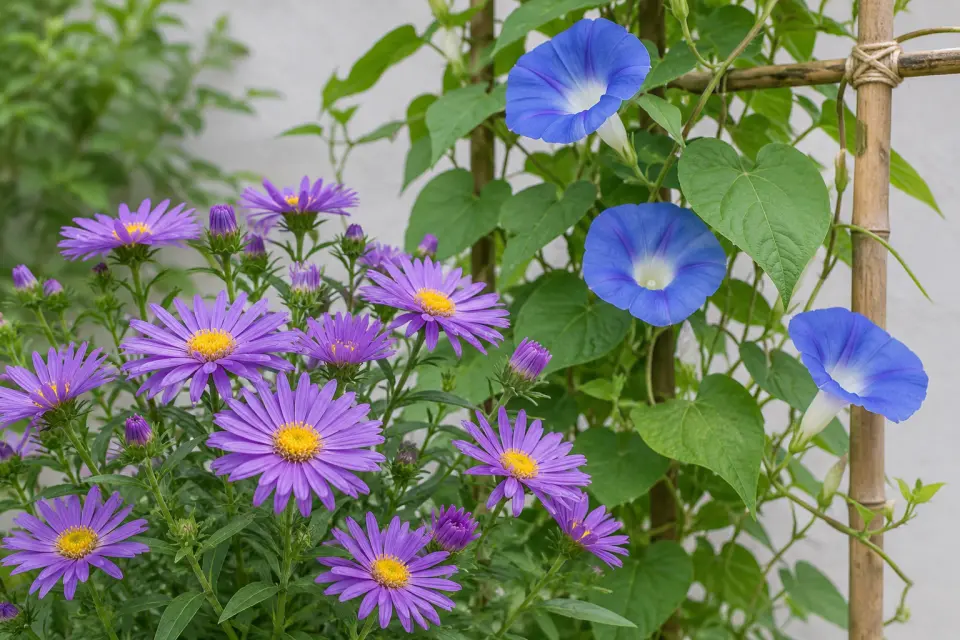
In many English lists, the September birth flowers are the aster and the morning glory. Both bloom as summer turns to autumn, which is likely why they were given to this month. A birth flower is a symbol tied to a month. It is not a portrait of people born in September.
Hartmann et al. (2006) did not find that birth date predicts personality. Controlled tests of birth-date or birth-chart personality prediction did not find an effect (Carlson, 1985; Hartmann et al., 2006). Those studies are about Western astrology and birth date. They are not a trial of these flowers.
Aster
The plant
The name comes from the Greek word aster, star, after the flower heads with thin rays around a central disc. What a list calls an aster can be several plants. The European Italian aster (Aster amellus) and the East Asian Tatarian aster (Aster tataricus) are still in the genus Aster. Most North American asters, such as the New England aster, are now placed in Symphyotrichum. The China aster sold as a cut flower is Callistephus chinensis, a separate genus. In Britain, autumn asters are called Michaelmas daisies because they bloom around Michaelmas, 29 September.
Old texts and a modern story
In Georgics book 4, Virgil describes a meadow flower called amellus, with a golden centre and purple rays, that is often woven into garlands for the altars of the gods. It is usually identified with Aster amellus. That is a description in a poem, not a recorded rite tied to September.
Many websites say asters sprang from the tears of Astraea, the star maiden, who wept because there were no stars on earth. In Ovid’s Metamorphoses, book 1, Astraea is the last of the immortals to leave the earth, but the story of her tears becoming asters is not in Ovid or other classical texts found so far. It is best read as a modern retelling. The claim that ancient people burned aster leaves to drive away snakes is also widely repeated without a clear source.
Meanings on the lists
In 19th-century English language-of-flowers books, such as Kate Greenaway’s (1884), the China aster stands for variety, and the Michaelmas daisy for afterthought. Wisdom, patience, and love are later popular glosses. Modern sites also give each color its own meaning, but those color tables differ from site to site and have no fixed older source.
Morning glory (Ipomoea)
The plant
Morning glories are climbing vines in the genus Ipomoea, in the same family as the sweet potato. Common garden kinds include Ipomoea purpurea, Ipomoea tricolor, and Ipomoea nil, the morning glory grown in Japan. In most of them, each flower opens in the morning and wilts by the end of the same day, while new buds keep opening through late summer and autumn.
Across traditions
In Chinese the plant is qianniu hua, the ox-leading flower. Tao Hongjing, a scholar of the 5th and 6th centuries, explained the name of its seeds as coming from a farmer who led an ox to thank the person whose seeds had cured him. Popular retellings also link the name to the cowherd Niulang of the Qixi story, but that is a later folk connection. The seeds were used in traditional Chinese medicine as a strong purgative. That is a historical use, not medical advice.
Japanese sources usually say Ipomoea nil arrived from China as a medicinal plant around the 8th or 9th century. In the Edo period it became a popular garden flower, and growers bred unusual forms called henka asagao. Japanese flower-language lists today often give bonds of love and brief love for it. Korean lists commonly give good news and fleeting love. These lists vary between publishers.
Meanings on the lists
In Kate Greenaway’s 1884 list, morning glory is given as affectation. Many modern lists give affection instead, along with love that lasts only a short time and a fresh start each morning. Those readings draw on the one-day flower, and they are recent glosses, not old definitions.
Safety: morning glory seeds are not food. Seeds of several kinds contain ergot-type alkaloids and can cause vomiting, confusion, and other effects if eaten. The ASPCA lists morning glory as toxic to cats and dogs. If a child, an adult, or a pet has swallowed seeds, call a poison center, a doctor, or a vet.
What the month symbol does not do
On these lists, the aster and the morning glory stand for the month of September. They do not say who a September-born person is, and they do not promise wisdom, love, or a new start. The plants are traditional pictures for the turn from summer to autumn, each with its own history, and that history is worth keeping apart from the meanings later lists have added.
References
- Carlson, S. (1985). A double-blind test of astrology. Nature, 318, 419–425.
- Hartmann, P., Reuter, M., & Nyborg, H. (2006). The relationship between date of birth and individual differences in personality and general intelligence: A large-scale study. Personality and Individual Differences, 40(7), 1349–1362.
- Virgil, Georgics, book 4 (amellus).
- Ovid, Metamorphoses, book 1 (Astraea).
- Greenaway, Kate. Language of Flowers (1884).
- ASPCA Animal Poison Control: toxic and non-toxic plants