April Birthstone Diamond: Eternal Love, Strength, and the Stone That Conquered Everything
Complete guide to April birthstone diamond — its history, symbolism of eternal love and unbreakable strength, crown chakra symbolism, the 4Cs explained, and lab-grown diamonds.
Last reviewed 2026-03-31
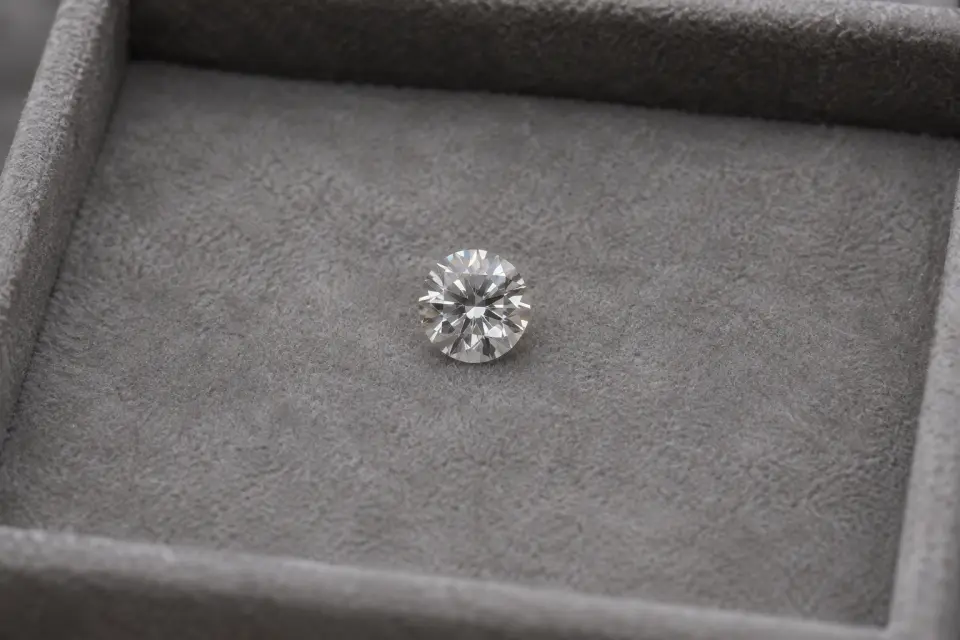
Spring reaches its full bloom in April, and this month’s birthstone matches that peak energy perfectly — diamond, the hardest natural substance on Earth and the world’s most iconic symbol of love, strength, and permanence. No other gemstone has captured the human imagination quite like the diamond. Its journey from deep within the Earth to your finger spans billions of years and countless cultures — each one recognizing something extraordinary in that crystallized carbon.
What Is a Diamond?
Diamond is pure carbon (C) in crystalline form, created deep within the Earth’s mantle (approximately 140–190 km below the surface) under extreme heat (~1,200°C) and pressure (~50 kbar); most formed roughly 1 to 3.5 billion years ago. Volcanic activity (kimberlite pipes) carries them toward the surface.
Mohs hardness: 10 — the absolute maximum on the hardness scale. Only another diamond can scratch it. Hardness is not the same as toughness, though: a sharp blow can still split a diamond along its cleavage planes. The name itself comes from the ancient Greek ‘adamas’ — “unconquerable.”
Major sources include Russia, Botswana, Canada, the Democratic Republic of the Congo, South Africa, and Angola. In 2024 a 2,492-carat rough diamond was found at the Karowe mine in Botswana — the second-largest on record after the 3,106-carat Cullinan, found in South Africa in 1905.
History
India: The Original Diamond Kingdom
Diamonds were first used in India around the 4th century BCE. The Golconda region was the world’s main source of diamonds until finds in Brazil in the early 18th century, producing legendary stones like the Hope Diamond and Koh-i-Noor that still carry historical weight today.
Ancient Indian lore held that diamonds formed where lightning struck the earth (the Sanskrit vajra means both thunderbolt and diamond), making them symbols of divine power. They were also said to serve as amulets that protected warriors in battle.
Ancient Greece and Rome
According to later retellings, Greeks thought of diamonds as tears of the gods or fragments of fallen stars. Some traditions held that Cupid’s arrows were tipped with diamonds, which is why diamonds became associated with love’s power.
The Engagement Ring Tradition
In 1477, Archduke Maximilian of Austria gave Mary of Burgundy a diamond engagement ring — often cited as one of the earliest recorded diamond engagement rings. The custom only became widespread much later.
The discovery of diamonds in South Africa in 1867, combined with De Beers’ legendary marketing campaign — “A Diamond is Forever” (1947) — cemented the diamond as the ultimate symbol of enduring love.
Chakras: Metaphors for a State of Mind
Diamonds look colorless, as if holding all colors at once. The spiritual meanings given to them in crystal culture grow out of that image.
Crown Chakra (Sahasrara)
Linking diamond to the crown chakra is inherited symbolism. Just as a diamond splits white light into a full spectrum, it stands for a clear mind that gathers scattered thoughts into one. It does not mean the body responds or consciousness actually changes.
The 「Master Healer」 Nickname
In crystal culture, clear diamond is sometimes called a master healer that clears all seven chakras. That is a nickname within a belief system, not a tested effect. If something feels wrong in your body, please see a doctor.
Core Meanings and Associations
Eternity Formed billions of years ago and impervious to scratching, the diamond embodies time, permanence, and unchanging value.
Strength Hardness 10 represents inner strength that cannot be broken by circumstance. For people going through the hardest periods of life, diamond is read as a symbol of the message “You can endure this.”
Purity Transparent and uncolored, diamonds represent pure intentions, clear minds, and truthful love.
Commitment Once exchanged as an engagement ring, diamond carries the weight of lifelong promise. It symbolizes long-term devotion and unwavering trust in any relationship.
Understanding the 4Cs
When evaluating or purchasing a diamond, these four factors determine quality:
| Criterion | Description |
|---|---|
| Carat | Weight (1 carat = 0.2g); larger diamonds are exponentially rarer and more valuable |
| Cut | The most important factor; determines how light reflects and creates sparkle |
| Color | D (colorless, highest) through Z (yellow tint); D-F is colorless, G-J near colorless |
| Clarity | Freedom from internal inclusions; FL (Flawless) is the highest grade |
Practical tip: For most buyers, G-H color with VS2–SI1 clarity offers beautiful diamond beauty at a significantly better value than flawless stones.
Lab-Grown Diamonds
Laboratory-grown diamonds are rapidly changing the industry. They are chemically and physically identical to natural diamonds (pure crystallized carbon), and usually cost far less than comparable natural stones.
Within crystal culture, opinions differ: some say the absence of billions of years of natural compression creates a different energy; others argue chemical identity means energetic identity. This is a matter of belief; what matters most is your intention and connection to the stone.
Working with Diamond
Jewelry and Intention Setting
The most meaningful use of diamond remains as jewelry — engagement rings, anniversary gifts, heirlooms. Each time you look at it, it reconnects you to the intention behind it.
Meditation
Some people hold a small raw diamond crystal (rough diamond) during meditation as a symbol for gathering their focus. It is an inherited ritual, not a proven way to activate chakras.
New Beginnings Ritual
Before a major life transition — a new year, a new career, a new chapter — hold a diamond and write your deepest intention on paper. Store them together. In crystal lore, diamond is believed to amplify and anchor that intention.
Care
Diamonds attract skin oils and quickly look dull. Soak them in warm water with mild detergent and clean with a soft brush. Moonlight and sage smoke are inherited symbolic rituals. Avoid chlorine bleach and harsh chemicals, which can damage the metal of the setting.
To the April-born reading this, or to anyone who needs a reminder that pressure creates beauty: the diamond spent billions of years being compressed in the deepest places on Earth before becoming the thing that catches the light in a ring. Your own story of pressure, patience, and transformation isn’t so different. The fifth C — Courage — may be the most important one of all.
References
The birthstone lists and the history and legends of each gem follow the sources below. Statements about chakras, healing, and energy describe inherited symbolism; in a controlled experiment, people reported the same effects from real and fake crystals (French et al., 2001).
- Kunz, G. F. (1913). The Curious Lore of Precious Stones. J. B. Lippincott.
- Gemological Institute of America. Birthstones. https://www.gia.edu/birthstones
- French, C. C., Williams, L., & O’Donnell, H. (2001). Crystal healing: A test of the placebo effect. British Psychological Society Centenary Annual Conference, Glasgow.