August Birthstone Peridot: Sunshine in Stone, Abundance and Renewal
Complete guide to August birthstone peridot — born from volcanoes and meteorites, solar plexus chakra symbolism, abundance, and the renewal meaning of a gem that only comes in green.
Last reviewed 2026-03-31
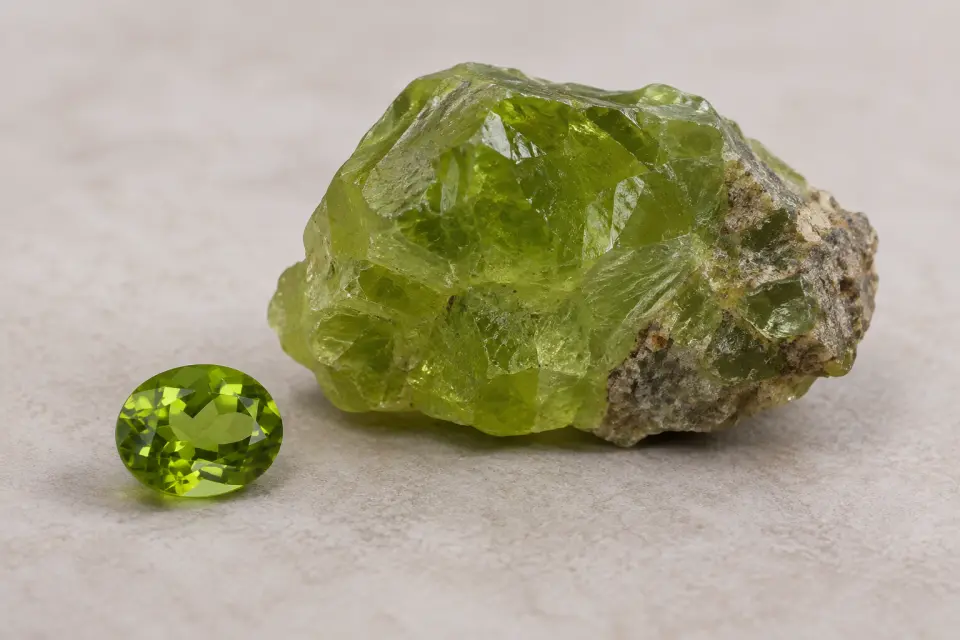
August arrives burning — one of the hottest, brightest months of the year in the Northern Hemisphere — and its birthstone carries that solar intensity perfectly. Peridot is one of the few gemstones that comes in a single color: green. Always green. Every shade of green from pale chartreuse to rich olive, but never anything but green. This chromatic purity isn’t a limitation — it’s a declaration. Peridot knows exactly what it is.
What Is Peridot?
Peridot is a variety of the mineral olivine (Mg,Fe)₂SiO₄, with the iron content determining whether the stone leans toward yellow-green or deeper olive-green. Because the iron that colors it is part of the crystal structure itself, peridot is always green. A clean stone can seem to glow from within, as if it had captured sunlight — it doesn’t actually emit light, but it’s easy to see why ancient Egyptians called it the gem of the sun.
Mohs hardness: 6.5–7 — somewhat softer than many popular gems; handle with moderate care.
Sources: Egypt’s Zabargad Island (historically the world’s sole source for millennia), USA (Arizona, on the San Carlos Apache Reservation), Pakistan, Myanmar, China, Ethiopia.
Peridot from Outer Space
Here’s something extraordinary: gem olivine is found in meteorites — specifically in pallasite meteorites, which contain olivine crystals embedded in iron-nickel metal. The famous Esquel pallasite from Argentina is one example. Olivine has also been detected on Mars and in comet dust brought back by NASA’s Stardust mission.
Peridot also forms in Earth’s upper mantle and reaches the surface through volcanic eruptions. On Hawaii’s Big Island, the waves are eroding an old cinder cone rich in olivine crystals, and the grains collect on the shore — creating the famous Green Sand Beach (Papakōlea). Jewelry sellers often call peridot the tears of Pele, the volcano goddess, but in Hawaii that name traditionally belongs to small droplets of volcanic glass, not to olivine.
This stone is born deep underground and delivered by eruption. It comes from far below the Earth’s crust (and beyond).
History
Cleopatra’s “Emerald” Problem
Egypt’s Zabargad Island in the Red Sea (known to the Greeks as Topazos) was the classic ancient source, and stories say the island and its mines were closely guarded. The Egyptians called peridot “the gem of the sun.”
Here’s a historical footnote: some historians believe that Cleopatra’s famous emerald collection may have contained significant quantities of peridot. Before modern gem testing, green stones were often confused with one another.
Peridot in Medieval Europe
Green gems were prized in medieval church treasures. The Shrine of the Three Kings in Cologne Cathedral — a masterpiece of medieval goldsmithing — is set with about 200 carats of green gems that were believed for centuries to be emeralds. They are actually peridot.
Chakra Symbolism
Chakras are a symbolic map of inner states, not organs of the body. What follows is the meaning crystal traditions attach to peridot.
Solar Plexus Chakra (Manipura)
Crystal traditions pair peridot’s yellow-green with the solar plexus chakra, placed between the navel and sternum. It stands for personal identity, self-confidence, willpower, and the ability to act on your intentions.
When you feel powerless, easily swayed by others, or unable to turn dreams into action, peridot can serve as a reminder to come back to your own center.
Heart Chakra (Anahata)
Peridot is also linked with the heart chakra — a symbol of letting go of jealousy and resentment, and of forgiving both oneself and others.
Core Meanings and Associations
Abundance & Prosperity Peridot is one of the stones most often linked with abundance in all its forms — financial, creative, relational, and spiritual. Think of it as a reminder to notice and tend what is already available to you.
Renewal & New Beginnings Like the volcanic activity that brings it up — which destroys but also creates new land — peridot symbolizes renewal: clearing away what’s outworn (relationships, beliefs, habits) so that new growth can occur.
Release of Jealousy and Anger Old lore credits peridot with driving away envy, resentment, and bitterness — the emotions that quietly poison from within. As a symbol, it invites you to redirect that energy toward appreciation and personal growth.
Self-Confidence For those who allow too much external influence, or who doubt their own worth and capability, peridot stands for a grounded, stable sense of self.
Working with Peridot
Wearing
Old lore held that peridot should be set in gold to show its full power, and the pairing of green and gold is still a classic. Wear it when starting new projects, entering negotiations, or any time you need to show up with confidence and personal authority.
Abundance Practice
Some people place peridot in a golden bowl or near thriving plants as a visual cue. Monthly, hold the stone and clearly picture your specific goals. An affirmation you could use: “I notice and tend the abundance already in my life.”
Emotional Clearing
When jealousy, resentment, or bitterness arises, hold peridot over your heart and solar plexus. Acknowledge the emotion honestly, then consciously invite its transformation. This isn’t about suppressing the feeling — it’s about composting it into something useful.
Care and Cleansing Rituals
- Cleaning: warm, soapy water and a soft brush are enough. Peridot is stable to light, but acids can etch it and sudden temperature changes can crack it, so avoid ultrasonic and steam cleaners (GIA).
- Symbolic cleansing rituals passed down in crystal practice include leaving the stone in moonlight or passing it through sage smoke.
For August babies, or for anyone who has been through the fire and wondered if they’d come out the other side: peridot came from deep inside the Earth. It traveled through volcanic eruption. Some of it traveled through outer space. And after all of that, it glows green — the color of life, of growth, of abundance. Whatever you’ve been through, you’re still here. Still glowing. That’s what peridot is trying to remind you.
References
The birthstone lists and the history and legends of each gem follow the sources below. Statements about chakras, healing, and energy describe inherited symbolism; in a controlled experiment, people reported the same effects from real and fake crystals (French et al., 2001).
- Kunz, G. F. (1913). The Curious Lore of Precious Stones. J. B. Lippincott.
- Gemological Institute of America. Birthstones. https://www.gia.edu/birthstones
- French, C. C., Williams, L., & O’Donnell, H. (2001). Crystal healing: A test of the placebo effect. British Psychological Society Centenary Annual Conference, Glasgow.