December Birthstone Tanzanite and Turquoise: Blue Stone, Inherited Symbols
December birthstones tanzanite and turquoise — one commercial source, Sinai mining, and inherited symbolism rather than a measured effect.
Last reviewed 2026-03-31
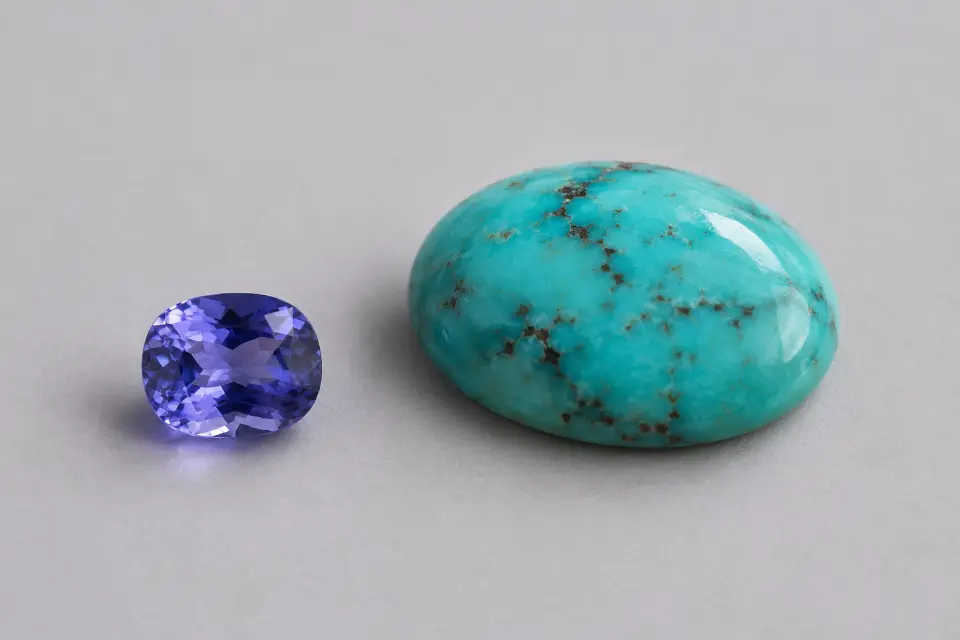
December’s birthstones are tanzanite and turquoise. Both read as blue, but the places they come from and the length of their histories are not the same. Wisdom, truth, and a new beginning are old inherited symbols. They are not a claim that the stone produces those effects.
Tanzanite, a blue-violet zoisite
Tanzanite is the blue-violet variety of zoisite. The only commercial source is the Merelani (Mererani) hills in northern Tanzania, near Kilimanjaro. The mining belt is commonly described as about 7 km long and 2 km wide.
GIA gives a Mohs hardness of 6 to 7. The stone has cleavage, so a ring is riskier than a pendant or earrings.
Trichroism is strong. Along different directions the colors are blue, violet, and a brownish red. Most commercial blue-violet stones are heated to quiet the brown. Published temperatures differ, roughly 370–600°C.
Discovery accounts differ. A Tanzanian government account names Jumanne Ngoma in January 1967. Trade history also tells a story of a Maasai and Manuel d’Souza. Tiffany & Co. named the stone tanzanite. The line that the English name blue zoisite sounded like blue suicide is an anecdote told about Henry Platt, not a verified quote. Tiffany’s 1968 marketing, which presented it as the most beautiful blue stone in 2,000 years, is advertising, not a measurement.
Crystal-healing custom has tied this color to intuition, change, and compassion, including talk of the third eye and the crown. That talk is inherited symbolism. It does not mean the stone turns a chakra on or heals the body.
Turquoise, a blue made by copper
Turquoise is a phosphate mineral. The formula is CuAl₆(PO₄)₄(OH)₈·4H₂O. Copper makes the blue; iron shifts it greener. Mohs hardness is 5 to 6. Oils, chemicals, and long sun hurt it.
The name comes from Old French for Turkish, because the stones reached Europe through Turkish lands. Historic fine material is Persian (Iran), not from Turkish mines.
Mining in Sinai is ancient. The 4th millennium BCE is the usual archaeological claim. Calling Hathor Lady of Turquoise is a known epithet; read it as tradition.
The Blue Mosque of Tabriz is Masjed-e Kabud. It is famous for blue ceramic tile. It is not a dome paved with the gem.
In Mesoamerica, chalchihuitl is a green-stone word covering jade and turquoise, not turquoise alone.
In the Southwest, turquoise is important among Navajo, Zuni, Hopi, and others. The four sacred stones are a Navajo teaching as commonly retold, not a fact about every nation. The Sleeping Beauty mine in Arizona is reported closed in 2012.
Protection, wisdom, healing, and friendship are inherited symbols. The stone is not a device that prevents accidents or heals the body.
Side by side
| Tanzanite | Turquoise | |
|---|---|---|
| Source | Only commercial source: the Merelani hills | Historic fine material: Persia (Iran) |
| Hardness | 6 to 7, with cleavage | 5 to 6; oils, chemicals, and long sun |
| Color | Blue, violet, and brownish-red trichroism | Copper makes the blue; iron shifts it greener |
| History | Differing accounts around 1967; Tiffany’s name | Sinai mining: usually the 4th millennium BCE |
| Symbols | Intuition and change, as inherited talk | Protection, speech, and friendship, as inherited talk |
A person born in December, or anyone closing a year, is looking at two different records of time. Tanzanite is a gem name with a single commercial source. Turquoise has a very long record of use. Wisdom and protection hung on the blue are symbols carried with that record.
References
Talk of chakras, healing, protection, energy, and friendship is inherited symbolism. A controlled experiment found no difference between real and fake crystals (French et al., 2001). Birthstone lists and the history and legends of the gems follow the sources below.
- Kunz, G. F. (1913). The Curious Lore of Precious Stones. J. B. Lippincott.
- Gemological Institute of America. Birthstones. https://www.gia.edu/birthstones
- French, C. C., Williams, L., & O’Donnell, H. (2001). Crystal healing: A test of the placebo effect. British Psychological Society Centenary Annual Conference, Glasgow.