June Birthstones Pearl and Alexandrite: Purity, Transformation, and Two Kinds of Magic
Complete guide to June birthstones pearl and alexandrite — history, energy, meaning, and how to work with these two extraordinary gems of dual nature.
Last reviewed 2026-03-31
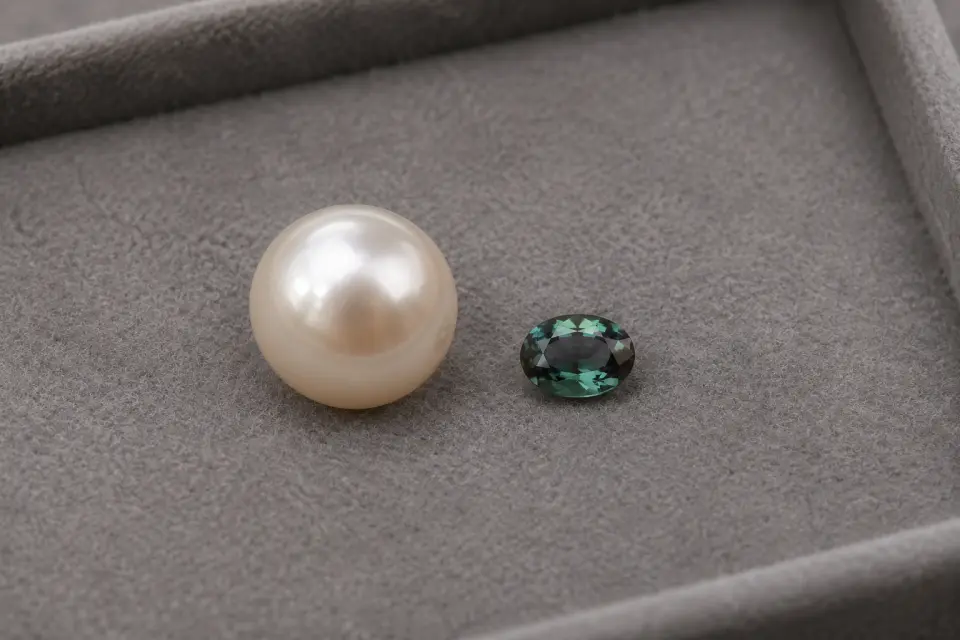
June is unusual in the birthstone world — it claims two gems as its own: the ancient, organic pearl and the astonishingly rare color-changing alexandrite. Together, they represent a beautiful paradox: pearl, born slowly inside a living creature, and alexandrite, discovered less than 200 years ago yet instantly legendary for its impossible color-shift ability. Both embody June’s essential energy — transformation, authenticity, and the magic of things that are not quite what they first appear.
Pearl: The Ocean’s Gift
What Is Pearl?
Pearl is the best-known gem created by a living organism (amber and coral are organic too) — and one of the very few that needs no cutting or polishing to reveal its beauty. When an irritant enters an oyster or mussel’s shell, the mollusk secretes layer after layer of nacre (mother of pearl) around it. Over months to years, this process creates a pearl.
Mohs hardness: 2.5–4.5 — relatively soft for a gemstone. Protect pearls from cosmetics, perfumes, and harsh chemicals, and store them separately from harder stones.
Types of Pearl:
- Akoya pearls: Japan’s classic round white cultured pearl (also farmed in China); the typical image of a pearl necklace
- South Sea pearls: Australia, Indonesia, Philippines; large (10-20mm); white or golden
- Tahitian pearls: “Black pearls”; dramatic dark tones from black to peacock green to charcoal
- Freshwater pearls: Mostly from China; wide variety of shapes and colors; more accessible price
History and Legend
Tears of the Gods: Across many cultures, pearls were likened to the tears of deities or of the moon. The Roman writer Pliny the Elder recorded the belief of his day that pearls formed from dew taken in by oysters.
Cleopatra’s Pearl Wager: According to the story Pliny tells, Cleopatra bet Mark Antony that she could host the most expensive dinner in history. She dissolved one of her two largest pearls — reportedly worth 10 million sesterces — in a cup of vinegar and drank it.
Pearls and Royalty: Queen Elizabeth I was famously fond of pearls. Many of her portraits show her draped in long ropes of pearls and gowns sewn with them. Pearls became synonymous with queenly elegance throughout European courts.
What Pearl Has Come to Mean
The meanings below are inherited symbolism, not effects a pearl has on mind or body.
Lunar and Feminine Energy Pearl’s connection to the moon, tides, and the rhythms of the ocean links it to intuition, emotional intelligence, and feminine wisdom.
Purity White pearl has been the traditional bridal gem for centuries — symbolizing pure love, new beginnings, and the clean slate of a committed relationship.
Wisdom Through Experience The oyster transforms an unwanted irritant into a thing of beauty through patient layering. Pearl teaches us that our challenges, when held with patience, become our wisdom.
Emotional Calm Like the deep ocean, pearl is a symbol of settled, grounded calm after emotional turbulence.
Alexandrite: The Day-Night Miracle
What Is Alexandrite?
Alexandrite is a variety of chrysoberyl with the extraordinary ability to change color dramatically based on lighting:
- In daylight or fluorescent light: green to bluish-green
- Under incandescent light or candlelight: red to purplish-red
The same stone looks emerald-green in sunshine and ruby-red by lamplight. The saying goes: “Emerald by day, ruby by night.” This phenomenon, called the alexandrite effect, is caused by the way its chromium content absorbs different wavelengths under different lighting conditions.
Mohs hardness: 8.5 — very durable; excellent for everyday jewelry.
History
In the 1830s, a remarkable stone was found in the emerald mines of Russia’s Ural Mountains. It was named alexandrite in honor of Tsarevich Alexander (the future Tsar Alexander II); a widely repeated story says it was named on his coming of age, his 16th birthday, in 1834.
Its colors — green and red — are said to have matched the military colors of Imperial Russia, making it symbolic of national pride and royal favor.
Fine natural alexandrite is now extraordinarily rare and can cost more per carat than comparable diamonds. Much of the “alexandrite” sold today is synthetic alexandrite or a color-change simulant such as synthetic sapphire — attractive stones, but not the natural gem.
What Alexandrite Has Come to Mean
Change and Adaptability Alexandrite’s most obvious symbolic gift is its demonstration that a single thing can reveal entirely different faces depending on how the light falls. This is the stone of those who must adapt to changing circumstances while remaining fundamentally themselves.
Intuition and Creativity Traditionally described as a mirror for the wearer’s inner state, alexandrite is associated with intuition, creativity, and the ability to see multiple paths forward.
Emotional Balance For those feeling torn between opposing needs, alexandrite symbolizes holding seemingly contradictory sides of the self together.
Good Fortune Regarded in Russian lore as a lucky stone, alexandrite carries a traditional association with favorable outcomes in both love and business.
Two Birthstones for One Complex Month
| Pearl | Alexandrite | |
|---|---|---|
| Symbolism | Calm, purity, accumulated wisdom | Change, adaptability, intuition |
| Formation | Patient layering inside a mollusk | Geological rarity |
| Fitting moments | Quiet reflection, weddings, new beginnings | Life transitions, creative work, balance |
| Durability | Handle with care | Excellent for daily wear |
June’s gift to its children is this: you contain multitudes. Like the pearl, you transform your hardships into something beautiful. Like the alexandrite, you show different facets of your authentic self in different lights. Neither your softness nor your complexity is a weakness. Both are evidence of how extraordinary you are.
References
The birthstone lists and the history and legends of each gem follow the sources below. Statements about chakras, healing, and energy describe inherited symbolism; in a controlled experiment, people reported the same effects from real and fake crystals (French et al., 2001).
- Pliny the Elder. Natural History, Book 9.
- Kunz, G. F. (1913). The Curious Lore of Precious Stones. J. B. Lippincott.
- Gemological Institute of America. Birthstones. https://www.gia.edu/birthstones
- French, C. C., Williams, L., & O’Donnell, H. (2001). Crystal healing: A test of the placebo effect. British Psychological Society Centenary Annual Conference, Glasgow.