May Birthstone Emerald: Love, Rebirth, and the Green of Eternal Spring
Complete guide to May birthstone emerald — Cleopatra legends, heart chakra lore, the philosophy of Jardin inner inclusions, love and abundance symbolism, and care tips.
Last reviewed 2026-03-31
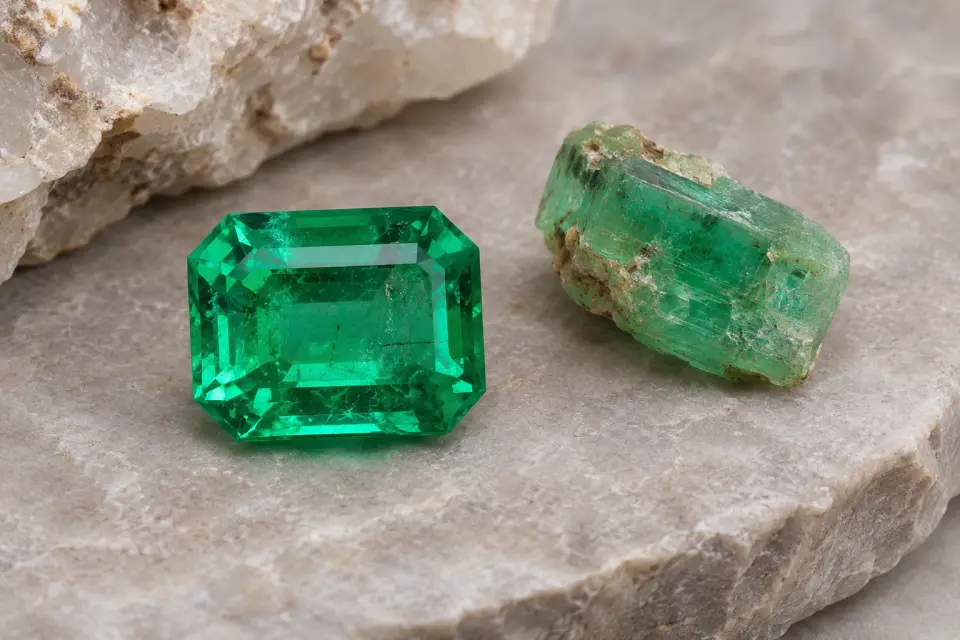
As the world reaches peak greenery in May — trees full, gardens lush, every living thing stretching toward the sun — this month’s birthstone mirrors that explosion of life perfectly. Emerald is one of the most cherished gemstones in human history, revered by pharaohs and emperors, worn by warriors and priests, gifted by gods and lovers. Its deep green holds a message that transcends time: love, growth, and the courage to begin again.
What Is Emerald?
Emerald is a variety of beryl mineral — the same family as aquamarine — with chromium (Cr) and vanadium (V) creating its signature deep green color. The higher the chromium content, the richer and more saturated the green.
Mohs hardness: 7.5–8, but emeralds are somewhat more fragile than their hardness suggests due to characteristic internal features (more on that below). Major sources include Colombia (world’s finest quality), Zambia, Brazil, Zimbabwe, and Ethiopia.
The most prized emeralds come from the Muzo mine in Colombia — producing deep, slightly bluish-green stones that gemologists consider the pinnacle of the species.
History and Legend
Cleopatra and Egypt’s Emerald Mines
No story in emerald history is more dramatic than Cleopatra’s. Queen Cleopatra VII of Egypt is said to have loved emeralds, and the mines of Egypt’s eastern desert were under royal control in her dynasty’s time. The area known as Cleopatra’s Mines (around today’s Wadi Sikait) was worked from at least the Ptolemaic period (around the 3rd century BCE), making it one of the oldest documented emerald sources.
A popular story says Cleopatra gave visiting dignitaries emeralds engraved with her likeness, but no surviving object or contemporary record confirms it, so treat it as legend. In the stories told about her, emeralds stand for eternal youth, abundance, and royal power.
India and the Mughal Empire
Mughal emperors treated emeralds as sacred objects, carving prayers and sacred inscriptions into large stones to wear as talismans. The Mughal Emerald, carved with a prayer and dated 1695 (now in the Museum of Islamic Art, Doha), is one of the most famous examples.
The Inca and Aztec Civilizations
Civilizations across Central and South America, including the Aztec and the Inca, prized emeralds as sacred gems for jewelry and ritual, and local peoples such as the Muzo had mined Colombian emeralds long before Europeans arrived. When Spanish conquistadors arrived, their hunger for emerald drove significant early exploitation of Colombian mines — bringing this stone to the world’s attention.
Biblical Tradition
In the Book of Revelation, the rainbow around God’s throne looks “like an emerald” (Rev. 4:3), and emerald is the fourth foundation stone of the New Jerusalem’s wall (Rev. 21:19), cementing its association with the divine in Western tradition.
Chakra Energy
Heart Chakra (Anahata)
In chakra tradition, green is the color of the heart chakra, so emerald is often called the quintessential heart chakra stone. In this symbolic system, the heart chakra stands for love, compassion, healing, gratitude, forgiveness, and the force that connects us to one another.
When the heart has been wounded — through betrayal, loss, or years of self-criticism — emerald serves as a gentle symbol of care. It doesn’t demand you “get over it.” It is simply a reminder to take your time while you remember how to feel love again.
Core Meanings and Associations
Love Every type of love falls within emerald’s domain — romantic love, self-love, familial love, universal compassion. It symbolizes the capacity to both give and receive love.
Rebirth & Growth Like spring itself, emerald carries the energy of new beginnings. When you feel stuck in old patterns, old pain, or old stories about who you are, emerald can serve as a symbol of gentle but profound renewal.
Abundance Since ancient times, emerald has been a stone of prosperity. Whether you seek financial abundance, creative fertility, or the richness of meaningful relationships, emerald is a traditional emblem of that expansive hope.
Wisdom In old gem lore, emerald was linked to foresight and prophecy, and it has come to symbolize discernment, wise decision-making, and seeing clearly through confusion.
Loyalty Emerald has long been told of as a stone of faithful, lasting love. In many anniversary lists, the 55th wedding anniversary is the emerald anniversary.
The Philosophy of Jardin
Here’s something beautiful about emerald that most gems can’t offer: emeralds are expected to have internal inclusions. These natural internal features — fractures, minerals, growth patterns — are called jardin (French for “garden”).
Eye-clean natural emeralds are rare, so an unusually clean stone is worth checking with a lab report (synthetic emeralds have inclusions too, so inclusions alone do not prove a stone is natural). The inclusions are each stone’s fingerprint — its history written in stone.
There’s deep wisdom here. Your own scars and imperfections are not flaws that diminish you. They are proof that you are real, that you have lived, that you are irreplaceable. The garden inside you makes you what you are.
Working with Emerald
Wearing
An emerald necklace sitting over the heart keeps this heart chakra symbol close. Wear it on meaningful occasions — important conversations, days of recovery, days when you need to give or receive love more openly.
Heart Chakra Meditation
Lie down and place emerald over your heart. Breathe slowly and deeply. With each inhale, imagine a calm green light. With each exhale, release what your heart no longer needs to carry. Affirmation: “I am worthy of love. I have love to give. I am enough.”
Abundance Intention
Place emerald in a golden bowl or near a thriving plant as a visible reminder of the prosperity you are working toward. The affirmation: “I notice the good things already in my life.”
Cleansing Methods
- Moonlight overnight
- Running water, briefly (most emeralds are treated with oil or resin to fill fractures, so avoid long soaks, hot water, and steam)
- Sage smoke
- Earth burial overnight
- Avoid: Ultrasonic and steam cleaners (can damage inclusions and fillers), harsh chemicals
To those born in May, or to anyone who needs to remember that growth and renewal are always possible: the emerald has been whispering the same message across more than two thousand years of human history. Your imperfections are your garden. Your scars are your story. And you — like the emerald — are beautiful precisely because you are real.
References
The birthstone lists and the history and legends of each gem follow the sources below. Statements about chakras, healing, and energy describe inherited symbolism; in a controlled experiment, people reported the same effects from real and fake crystals (French et al., 2001).
- Kunz, G. F. (1913). The Curious Lore of Precious Stones. J. B. Lippincott.
- Gemological Institute of America. Birthstones. https://www.gia.edu/birthstones
- French, C. C., Williams, L., & O’Donnell, H. (2001). Crystal healing: A test of the placebo effect. British Psychological Society Centenary Annual Conference, Glasgow.