November Birthstone Topaz & Citrine: Golden Light, Abundance, and Joy
Complete guide to November birthstones topaz and citrine — solar plexus energy, abundance manifestation, and how these golden gems carry warmth through the darkening year.
Last reviewed 2026-03-31
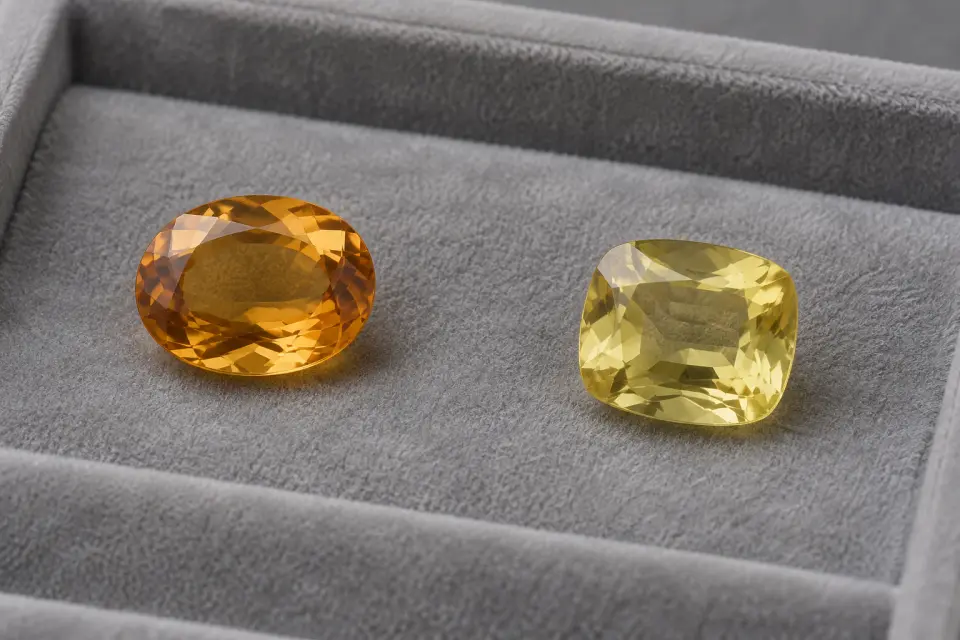
As November deepens into the darkening half of the year — shorter days, longer nights, the last warmth of autumn fading — its birthstones glow like captured sunlight: topaz in its golden imperial form, and citrine in its warm amber and lemon-yellow clarity. These are stones of inner warmth, abundance, and the particular joy that comes not from circumstances, but from alignment with one’s own light.
Topaz: The Full Spectrum
What Is Topaz?
Topaz is an aluminum silicate fluoride hydroxide mineral (Al₂SiO₄(F,OH)₂) — a relatively complex chemical formula that produces one of the hardest, most durable, and most beautifully varied gemstones. In its pure form, topaz is colorless. Impurities and structural defects create its remarkable color range: yellow, orange, pink, red, blue, green, and the stunning Imperial Topaz in its golden orange-red.
Mohs hardness: 8 — among the hardest gemstones; only a few, such as chrysoberyl, corundum (ruby/sapphire), and diamond, are harder. Topaz does have perfect cleavage, though, so a sharp knock can split it.
Major Sources: Brazil (the world’s primary source for Imperial Topaz, specifically the Ouro Preto region), Pakistan (pink and orange topaz), Russia (historically; Ural Mountains), Sri Lanka, Nigeria, USA (Utah — state gemstone).
The Color Question
The gem market for topaz is, frankly, confusing:
- Blue topaz (the most widely sold variety) is almost always colorless topaz that has been irradiated and heat-treated. Natural blue topaz exists but is rare.
- Imperial Topaz (golden orange to orange-red with pink undertones) is the most prized and genuinely natural color — deep golden with a warm intensity that catches light magnificently.
- Precious Topaz refers to the yellow through orange-red natural colors.
In crystal traditions, natural topaz — particularly Imperial Topaz — is often preferred, though all varieties share the same symbolism.
History
The Island of Topazos The word “topaz” is often traced to Topazos, the ancient Greek and Roman name usually identified with Zabargad Island in the Red Sea. Curiously, the island is known for peridot, not topaz, so the yellow-green stone the ancients called topazos was probably peridot. Another proposed source is the Sanskrit tapas, “fire.”
Ancient Egypt: Ra’s Stone According to popular gem lore, Egyptians linked golden topaz to Ra, the sun god. They believed the stone’s color came directly from the sun’s golden rays and that it carried protective power from that divine source.
Medieval Europe: The All-Healer Medieval lapidaries (gemstone encyclopedias) attributed extraordinary healing properties to topaz — including the ability to cool boiling water (demonstrating its cooling, calming energy), improve eyesight, cure insomnia, and protect against poison.
The Braganza Diamond The famous Braganza “diamond” in the Portuguese Crown Jewels — a 1680-carat stone considered the largest diamond in the world for centuries — is now believed to be a colorless topaz.
Chakra Energy
The chakra links and meanings below come from modern crystal traditions. They are symbolism, not tested effects.
Solar Plexus Chakra (Manipura) Golden and Imperial Topaz resonate most directly with the solar plexus chakra — the seat of personal power, self-confidence, and the ability to manifest intentions in the physical world. When solar plexus energy is strong, we feel capable, directed, and aligned with our own authority.
Crown Chakra (Sahasrara) Blue and colorless topaz supports the crown chakra — spiritual connection, clarity of consciousness, and access to higher perspective.
Throat Chakra (Vishuddha) Blue topaz activates the throat chakra, supporting honest self-expression, clear communication, and the courage to speak one’s truth.
Core Meanings
Manifestation and Intention Topaz is called a “stone of manifestation” — a symbol of turning intentions and visions into action. Its hardness (8 on Mohs) makes a fitting metaphor: focused and durable.
Generosity and Abundance Topaz carries an expansive abundance energy — not hoarding or grasping, but the generous abundance of someone who trusts that there is enough. As a symbol, topaz points toward giving and receiving freely.
Clarity of Purpose For those who feel directionless or scattered, topaz (particularly Imperial Topaz) can serve as a reminder to clarify what genuinely matters and to cut through distractions and act with purpose.
Citrine: The Merchant Stone
What Is Citrine?
Citrine is a variety of quartz (SiO₂), ranging in color from pale lemon yellow to deep amber and orange-brown. The color comes from traces of iron within the quartz crystal structure. Natural citrine is relatively rare — the majority of commercial citrine is actually amethyst or smoky quartz that has been heat-treated, which turns those stones from purple/gray to yellow-orange.
Mohs hardness: 7 — durable and practical for everyday jewelry.
Major Sources: Brazil (largest producer), Spain, Bolivia, Madagascar, Russia, USA.
The Heat-Treatment Question
Most citrine sold commercially is heat-treated amethyst. The two materials are chemically identical (both quartz); the difference is the color. Amethyst’s purple comes from iron impurities combined with natural irradiation, and heating alters those color centers. When heated to approximately 470°C, amethyst turns yellow-orange.
Natural citrine (mined as yellow quartz, without treatment) is usually pale and evenly colored, while clusters with whitish bases and deep orange-brown tips are typically heated amethyst. A gem lab can confirm which is which. In crystal traditions both share the same symbolism; some practitioners simply prefer natural stones.
History
The Merchant Stone Citrine’s best-known association in today’s crystal culture is with commerce and prosperity. The custom of keeping citrine in a cash box or wallet to attract customers and sales is widely repeated, but there is no reliable record of it going back to ancient Rome. Older lore, as GIA notes, says citrine was carried as protection against snake venom and evil thoughts.
Art Deco Glamour The 1920s and 1930s saw an explosion of citrine in fine jewelry. Its warm amber tones perfectly suited Art Deco aesthetics. Large statement pieces — cocktail rings, long necklaces, dramatic brooches — were often set with substantial citrine crystals. Hollywood celebrities and European royalty wore them to great effect.
Scotland’s Cairngorm Tradition Scotland’s Cairngorm mountains gave their name to a local smoky quartz. Cairngorm and yellow quartz (citrine) were set widely in traditional Scottish jewelry, particularly the brooches and kilt pins of Highland dress.
Citrine’s Special Property: Self-Cleansing
Uniquely among crystals, citrine is widely believed to be self-cleansing — it does not accumulate negative energy in the way most stones do, and it radiates positive, clearing energy outward rather than absorbing negativity inward. In that tradition, it is one of the few stones said not to need regular energetic cleansing.
For that reason, practitioners often place citrine where energy is felt to stagnate: workplaces, corners of rooms, near electronic devices, or anywhere that feels energetically heavy.
Chakra Energy
As with topaz, the meanings below are inherited symbolism.
Solar Plexus Chakra (Manipura) Like topaz, citrine resonates powerfully with the solar plexus chakra — personal power, self-confidence, the capacity to act on one’s own values, and the fundamental sense of “I can.”
Sacral Chakra (Svadhisthana) Citrine also connects to the sacral chakra, supporting creativity, emotional flow, playfulness, and the ability to experience pleasure and abundance without guilt.
Core Meanings
Abundance and Prosperity Citrine is the quintessential abundance stone in crystal culture — a symbol of an abundance mindset: seeing opportunity, acting with confidence, and keeping a hopeful orientation toward prosperity.
Joy and Optimism The color alone communicates it: citrine’s warm yellow-orange is the color of sunlight, of warmth, of genuine happiness. As a symbol, citrine stands for optimism — not naive positivity, but a grounded trust that things generally work out and that there is always something worth being grateful for.
Creativity and Self-Expression In crystal symbolism, citrine is linked to the creative center (sacral chakra) and to loosening the blocks — self-doubt, creative fear, perfectionism — that keep creativity from flowing.
Confidence For those who struggle with imposter syndrome or self-doubt, citrine can be a small visual reminder: you are capable, you are worthy, and your light is needed.
Working with November’s Birthstones
Wearing
Both topaz and citrine look spectacular set in yellow gold — the metal echoes their warm, solar color. Wear either stone when beginning new projects, entering important meetings, negotiating, or any time you want to project confidence and warm authority.
Abundance Practice
Place citrine in your wallet, near your work area, or in the wealth corner of your space (far left from the entrance, in feng shui). Monthly, hold the citrine and visualize your abundance goals specifically and joyfully. The affirmation: “Abundance flows to me easily, in ways that benefit both myself and others.”
Citrine Energy Clearing
Use citrine as a room-clearing crystal. Place a cluster or large point in any space that feels stagnant, heavy, or energetically difficult. In crystal tradition, its self-cleansing quality means it is said to need little attention.
Cleansing Methods
Topaz:
- Moonlight (avoid long sun exposure; some yellow-brown topaz can fade)
- Running water (water-safe)
- Sage or palo santo smoke
- Sound: singing bowl
Citrine:
- Moonlight (recommended; sufficient given self-cleansing property)
- Brief sunlight (citrine can handle moderate sun exposure; prolonged direct sun may fade color)
- Sage smoke
- Water (brief exposure fine; avoid extended soaking)
November’s birthstones are not coincidentally the color of the harvest — of ripe grains, of turning leaves, of the golden afternoon light that comes in autumn when the sun sits lower and casts everything in warmth. Topaz and citrine carry that harvest energy: the satisfaction of what has been built, the abundance of what has been gathered, the confidence that comes from having navigated another year of experience.
For November babies, or for anyone entering a season of deepening darkness who needs to remember that the light is still there: citrine and topaz hold it. Whatever abundance you’re working toward, whatever joy you’re cultivating, whatever light you’re trying to keep alive through the winter — these stones remember that the sun always returns.
References
The birthstone lists and the history and legends of each gem follow the sources below. Statements about chakras, healing, and energy describe inherited symbolism; in a controlled experiment, people reported the same effects from real and fake crystals (French et al., 2001).
- Kunz, G. F. (1913). The Curious Lore of Precious Stones. J. B. Lippincott.
- Gemological Institute of America. Birthstones. https://www.gia.edu/birthstones
- French, C. C., Williams, L., & O’Donnell, H. (2001). Crystal healing: A test of the placebo effect. British Psychological Society Centenary Annual Conference, Glasgow.