October Birthstone Opal & Tourmaline: The Spectrum of All Colors
Complete guide to October birthstones opal and tourmaline — play-of-color, hardness and care, Roman and later legends, and the chakra symbolism attached to them.
Last reviewed 2026-03-31
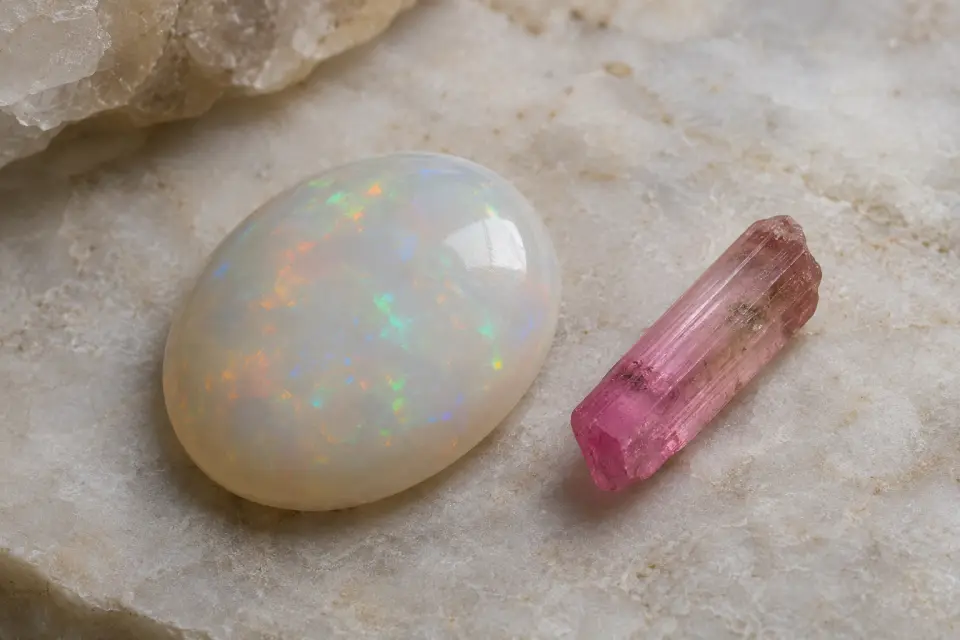
October arrives in a blaze of color — the burning oranges and reds of autumn leaves — and its birthstones match the season perfectly. Opal contains every color of the spectrum within a single stone. Tourmaline spans more colors than any other gemstone family. October’s two birthstones are, in essence, a celebration of color itself: the idea that beauty is not found in a single hue, but in the full, luminous spectrum.
Opal: The Stone That Contains Everything
What Is Opal?
Opal is a hydrated amorphous form of silica (SiO₂·nH₂O) — technically not a crystal, but a mineraloid, because it lacks a defined crystalline structure. What makes opal uniquely extraordinary is play-of-color: the shifting, iridescent display of spectral colors that appears to dance inside the stone as it moves under light.
This phenomenon occurs because opal contains tiny silica spheres arranged in a regular grid. When light enters, it diffracts (bends) around these spheres and interferes with itself — producing different wavelengths (colors) depending on the angle of observation. The size of the silica spheres determines which colors appear: smaller spheres produce violet and blue; larger spheres produce red and orange.
Mohs hardness: 5.5–6.5 — significantly softer than most gemstones; requires careful handling and storage.
Water content: 3–21% water by weight, which means opal can crack if it dries out too rapidly (called “crazing”). Avoid sudden temperature changes and prolonged dry conditions.
Major Sources: Australia (most of the world’s precious opal — Lightning Ridge for black opal, Coober Pedy for white opal), Ethiopia (newer source, highly prized), Mexico (fire opal), Brazil.
Types of Opal
| Type | Description |
|---|---|
| Black Opal | Dark body tone makes play-of-color appear most vivid; rarest and most valuable |
| White Opal | Milky white background; classic and most widely available |
| Fire Opal | Orange to red body color; from Mexico; often transparent |
| Boulder Opal | Opal in ironstone matrix; Queensland, Australia |
| Ethiopian Opal | Often honey or chocolate body tone; highly prized for vivid play-of-color |
History
Ancient Rome: The Queen of Gems The Roman senator Nonius famously chose exile over selling his single opal to Mark Antony. Pliny the Elder described opal as containing “a fire softer than the carbuncle, the purple of amethyst, the sea-green of emerald — all shining together in an incredible union.” The Romans called it opalus; the word is usually traced to Sanskrit upala, “precious stone.”
Aboriginal Australia: The Creator’s Footprint A widely retold story, attributed to Aboriginal Australian tradition, says that opal marks where the Creator God first touched the Earth — a divine footprint that transformed the ground into shimmering stone. The connection between opal and creation, between opal and the divine, runs deep in the culture of the land where most of the world’s finest opal is found.
The “Unlucky” Myth A superstition that opal brings bad luck spread in 19th-century Europe (later softened into the idea that it is unlucky only for those not born in October). It is usually traced to Sir Walter Scott’s 1829 novel Anne of Geierstein, in which an opal acts as a plot device (turning red and pale at dramatic moments). There is no historical basis for opal being unlucky — quite the opposite.
Chakra Symbolism
The following is inherited crystal-culture symbolism, not a claim that the stone acts on mind or body.
Crown Chakra (Sahasrara) Opal’s full-spectrum play-of-color is linked with the crown chakra, which stands for spiritual connection and wider awareness. Some people keep an opal nearby in meditation as a reminder of unity and inspiration.
Solar Plexus Chakra (Manipura) Fire opal is linked with the solar plexus, a symbol of personal power, confidence, and the courage to be oneself.
Core Meanings
Amplification of Emotion Opal is called “the stone of amplification” in crystal lore — a stone said to mirror and magnify the mood already present. Read it as a metaphor: a nudge to notice what you are feeling.
Creativity and Inspiration Artists, writers, musicians, and anyone engaged in creative work have long prized opal as a symbol of inspiration and ideas that flow freely.
Transformation and Change Like autumn itself — which transforms one state into another — opal stands for moving through transitions with grace, releasing what is no longer needed and embracing new forms.
Tourmaline: The Rainbow Gem
What Is Tourmaline?
Tourmaline is a complex boron silicate mineral with one of the widest color ranges of any gemstone family. A single tourmaline crystal can contain multiple colors in distinct zones — the famous watermelon tourmaline is green on the outside and pink in the center, sliced like its namesake fruit.
The name derives from the Sinhalese turamali, meaning “stone of mixed colors.”
Mohs hardness: 7–7.5 — durable and suitable for everyday jewelry.
Major Sources: Brazil (world’s largest producer), Nigeria, Mozambique, Madagascar, Afghanistan, USA (Maine and California historically produced significant stones).
Tourmaline Colors and Varieties
| Variety | Color | Notes |
|---|---|---|
| Rubellite | Deep red to pink | Rare; resembles ruby in intensity |
| Indicolite | Blue to blue-green | Often treated to enhance color |
| Verdelite | Green | Wide range of greens |
| Paraíba | Neon blue-green | Contains copper; exceptionally rare and valuable |
| Watermelon | Pink interior, green exterior | Bi-colored; highly distinctive |
| Schorl | Black | Most common variety; protective properties |
| Achroite | Colorless | Rare |
History
Arrival in Europe: Dutch traders brought tourmaline from Sri Lanka to Europe around the late 17th and early 18th centuries.
The Confusion with Other Gems: For centuries, large red tourmalines (rubellites) were mistaken for rubies. The famous “Caesar’s Ruby” pendant, once given to Catherine the Great and now in Russia’s Diamond Fund, is known to be a rubellite. Many historic “rubies” turned out to be other red stones, such as spinel or tourmaline.
Pyroelectric and Piezoelectric Properties: Tourmaline generates an electrical charge when heated or squeezed — a property discovered by Dutch traders who noticed tourmaline attracted ash from pipes (hence an early Dutch name: aschentrekker, “ash puller”). This electrical property has made tourmaline useful in scientific instruments; it does not support claims that the stone changes a person’s energy.
Chakra Symbolism
Heart Chakra (Anahata) Pink and green tourmaline are linked with the heart chakra — a symbol of opening the heart again after loss or disappointment, and of compassion toward self and others.
Root Chakra (Muladhara) Black tourmaline (schorl) is one of the most widely used protective symbols, linked with the root chakra and the idea of feeling grounded.
All Chakras The full tourmaline rainbow means different colors address different chakras. In this tradition, a multi-colored tourmaline or a “tourmaline set” stands for the whole chakra column.
Core Meanings
Protection Black tourmaline is considered one of the most powerful protective stones in crystal lore. It is traditionally placed at the four corners of a room or worn as a symbol of boundaries. Claims that it blocks EMF have no evidence behind them.
Emotional Renewal Pink and watermelon tourmaline symbolize matters of the heart — grief, heartbreak, self-criticism, and the gradual reopening of a heart that has closed in protection. If grief or low mood weighs on you for a long time, talking with a professional helps more than any stone.
Inspiration Like opal, tourmaline in its many forms is a symbol of creative work and the free flow of inspiration.
Working with October’s Birthstones
Wearing
Opal set in silver or white gold preserves its cool, luminous quality. Wear it for creative projects or when navigating emotional transitions. Tourmaline — particularly black, pink, or watermelon — can be worn daily; black tourmaline especially pairs beautifully as a protective pendant.
Cleansing
The cleansing rituals below are custom, not physics; the care notes are the practical part.
Opal:
- Moonlight
- Brief sage or palo santo smoke
- Sound: Tibetan singing bowl
- Care: wipe with a soft cloth or warm soapy water; avoid soaking (especially doublets and triplets), heat, harsh chemicals, and salt
Tourmaline:
- Running water (durable and water-safe)
- Moonlight or brief sunlight
- Sage or palo santo smoke
- Burying in earth overnight (especially for black tourmaline)
Protective Practice with Black Tourmaline
Place a piece of black tourmaline near your front door, on your desk, or beside electronic devices. Set the intention: “This stone holds the boundary. What does not serve me does not enter here.” For particularly intense environments, place four pieces at the corners of your room or home.
October’s two birthstones ask the same question in different ways: what does it mean to hold the full spectrum? Opal does it within a single stone, every color of light dancing simultaneously across its surface. Tourmaline does it across its many varieties — the pink of the heart, the green of growth, the black of protection, the blue-green neon of Paraíba that looks like captured electricity.
To be born in October, or to work with October’s stones, is to be invited into the fullness of experience — not one color, but all of them, changing as the light changes, beautiful in each moment.
References
The birthstone lists and the history and legends of each gem follow the sources below. Statements about chakras, healing, and energy describe inherited symbolism; in a controlled experiment, people reported the same effects from real and fake crystals (French et al., 2001).
- Kunz, G. F. (1913). The Curious Lore of Precious Stones. J. B. Lippincott.
- Gemological Institute of America. Birthstones. https://www.gia.edu/birthstones
- French, C. C., Williams, L., & O’Donnell, H. (2001). Crystal healing: A test of the placebo effect. British Psychological Society Centenary Annual Conference, Glasgow.